Kassaisaurus from Congo, 1932: Johanson Hoax, ‘Chimpekwe’, and the Later ‘Kasai Rex’
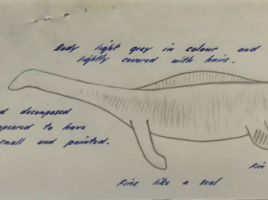
In July 1932, the South African Franz Grobler reported in the Cape Argus on his investigations in Central Africa concerning a creature referred to by local populations as the ‘Chepekwé’ or ‘water lion’. He described it as a large, reptile-like animal, allegedly weighing up to four tons, inhabiting swamp environments and said to prey on rhinoceroses, hippopotamuses, and elephants. Grobler, who had previously participated in an expedition led by the German filmmaker Hans Hermann Schomburgk, further claimed that a German scientist had discovered the creature six months earlier. He asserted that he had seen photographic evidence.
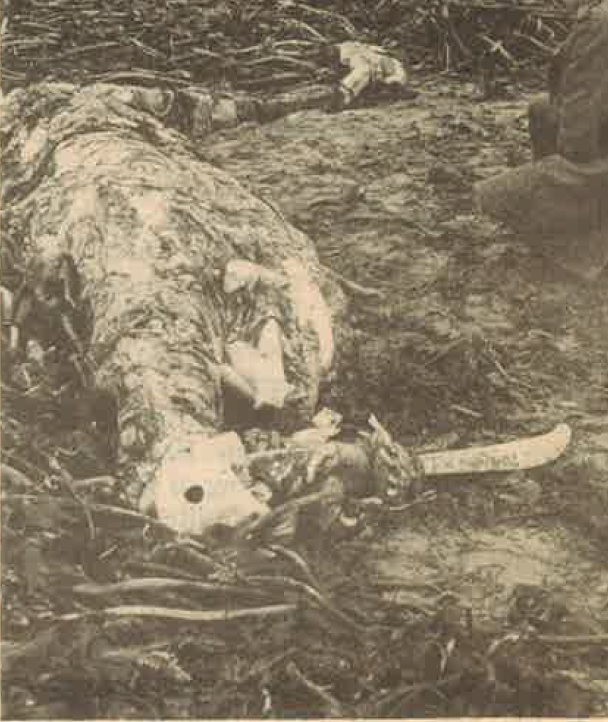
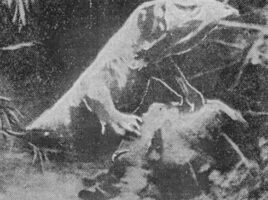
The newspaper account was supplemented by an additional report, attributed to a Swedish plantation overseer named J. C. Johanson, which described an encounter with a similar creature in the Kasai region of the Congo. According to this account, the animal measured approximately sixteen yards in length and possessed a lizard-like head and tail. The historical development in literature, was reproduced in the newspapers and presented as confirmative evidence, showing a large reptilian creature positioned atop a dead prey animal.
In 1955, the (crypto-)zoologist Bernard Heuvelmans identified the published image as a photomontage, combining a Komodo dragon with the body of a dead rhinoceros or hippopotamus. On this basis, he dismissed the Johanson account and its presumably associated photographic evidence as fraudulent. Grobler’s role was treated more ambiguously: Heuvelmans interpreted his statements as confused and embellished, yet later classed the Grobler report itself among the fallacious accounts partly derived from the Johanson material. Despite this exposure, the depicted reptile underwent further transformation within popular culture, where it was reimagined as a reddish, sometimes striped, theropod-like creature and subsequently became known as the ‘Kasai Rex’.
This article examines the history of the Grobler and Johanson accounts through a range of primary and secondary sources, including contemporary newspaper coverage, popular scientific literature, and general-interest publications. It explores the German-language context surrounding Schomburgk and the ‘Chimpekwe’, and draws attention to a seemingly overlooked ‘Chimpekwe’ report. It introduces the previously unidentified German-language source underlying the Johanson report, presents associated photographic material, and reconstructs the original designation of the creature as ‘Kassaisaurus’. Finally, the article analyses an additional report from the illustrated press that clarifies the nature of the Johanson case and demonstrates that it constitutes a particular form of journalistic hoax.