Kassaisaurus from Congo, 1932: Johanson Hoax, ‘Chimpekwe’, and the Later ‘Kasai Rex’
Article updated: 07.06.2026
Introduction
In July 1932, the South African Franz Grobler reported in the Cape Argus on his investigations in Central Africa concerning a creature referred to by local populations as the ‘Chepekwé’ or ‘water lion’. He described it as a large, reptile-like animal, allegedly weighing up to four tons, inhabiting swamp environments and said to prey on rhinoceroses, hippopotamuses, and elephants. Grobler, who had previously participated in an expedition led by the German filmmaker Hans Hermann Schomburgk, further claimed that a German scientist had discovered the creature six months earlier. He asserted that he had seen photographic evidence.
The newspaper account was supplemented by an additional report, attributed to a Swedish plantation overseer named J. C. Johanson, which described an encounter with a similar creature in the Kasai region of the Congo. According to this account, the animal measured approximately sixteen yards in length and possessed a lizard-like head and tail. An accompanying photograph was reproduced in the newspapers and presented as confirmatory evidence, showing a large reptilian creature positioned atop a dead prey animal.
In 1955, the (crypto-)zoologist Bernard Heuvelmans identified the published image as a photomontage, combining a Komodo dragon with the body of a dead rhinoceros or hippopotamus. On this basis, he dismissed the Johanson account and its presumably associated photographic evidence as fraudulent. Grobler’s role was treated more ambiguously: Heuvelmans interpreted his statements as confused and embellished, yet later classed the Grobler report itself among the fallacious accounts partly derived from the Johanson material. Despite this exposure, the depicted reptile underwent further transformation within popular culture, where it was reimagined as a reddish, sometimes striped, theropod-like creature and subsequently became known as the ‘Kasai Rex’.
This article examines the history of the Grobler and Johanson accounts through a range of primary and secondary sources, including contemporary newspaper coverage, popular scientific literature, and general-interest publications. It explores the German-language context surrounding Schomburgk and the ‘Chimpekwe’, and draws attention to a seemingly overlooked ‘Chimpekwe’ report. It introduces the previously unidentified German-language source underlying the Johanson report, presents associated photographic material, and reconstructs the original designation of the creature as ‘Kassaisaurus’. Finally, the article analyses an additional report from the illustrated press that clarifies the nature of the Johanson case and demonstrates that it constitutes a particular form of journalistic hoax.
History in literature and other media
The historical development of the case in literature and other media has been reconstructed in chronological order wherever possible. Works that contain only limited or redundant information—particularly where such material has already been documented elsewhere—are included exclusively in the reference list and are not discussed in detail.
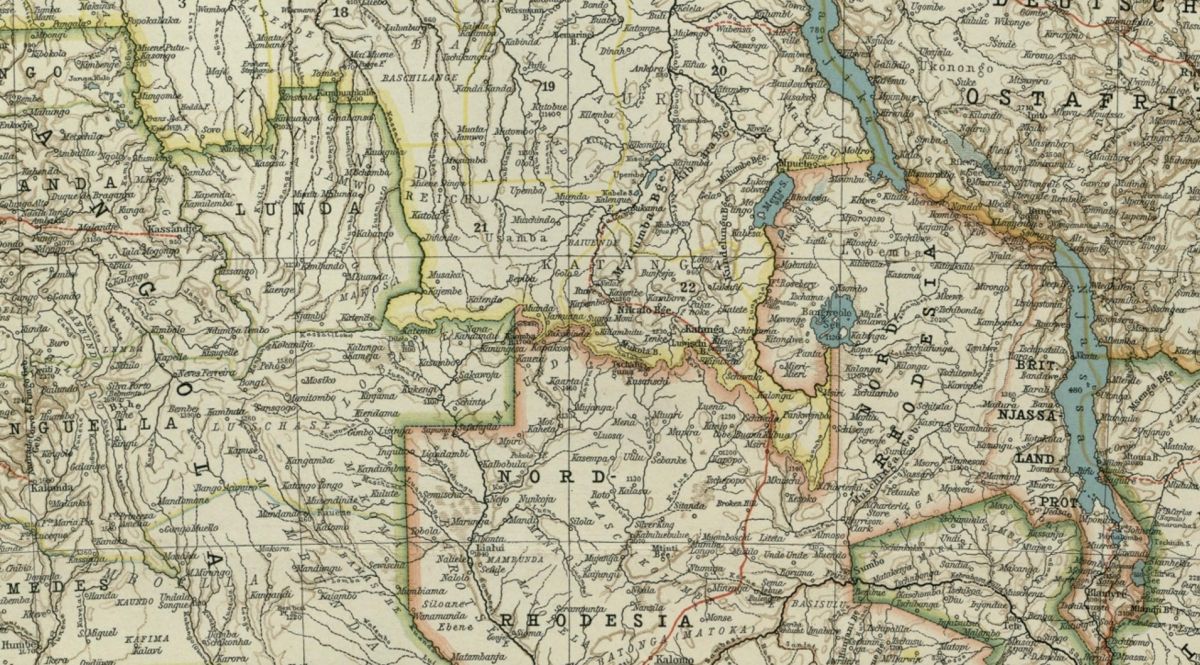
Figure 1. Map showing parts of Angola, the Belgian Congo, and Northern Rhodesia, including Lake Bangweolo, Lake Dilolo, and the relevant Kassai region. Source: Scobel (1921). Public domain.
It should be noted that all sources cited in this article must be understood within their respective historical contexts, particularly those shaped by colonialism and the rise of National Socialism in Germany. Any racist language or perspectives encountered in the cited material are reproduced solely for the purposes of critical analysis and historical accuracy and do not reflect the views of the author.
— — —
To the best of current knowledge, the earliest known printed account of Grobler’s ‘Chepekwé’ report appeared on 5 July 1932 in the Cape Argus, a local newspaper in Cape Town:
‘Mystery animal of African swamps?
Monster described by natives
Museum authorities sceptical
Claims that an animal new to science had recently been discovered in Angola are put forward by a young South African big-game hunter, F. Grobler, who is now in Cape Town after spending five years in Central Africa. Despite the scepticism of museum authorities, Grobler remains convinced that this animal is not a mythical counterpart to the sea serpent or the unicorn. „It is known by the native name of ‘Chepekwé,’“ he stated in an interview. “The natives in Central Africa used to call it the water lion. It can best be described as a huge iguana, the weight of which is estimated at about four tons or more. It was discovered about six months ago by a German scientist in the Dilolo Swamps in Angola, and while I was in that country I saw photographs of it.
What the natives say
“I went to Lake Dilolo myself to look for it, but I did not see it. The natives say it is extremely rare and seldom seen, but they are as convinced as I am of its existence. It lives only in swamps and from what I was told, it attacks rhino, hippo and elephant. I have seen a photograph of the ‘chepekwe’ on top of a hippo it had killed.” Mr. Grobler rejected the suggestion that the “chepekwe” might be a huge crocodile magnified by native imagination into a new animal. He said that during his hunting trips in Angola and the Congo he had often heard of it from natives. Mr. Grobler has been acting as guide to the Schomburgk expedition, which has recently returned to Germany after a year spent in filming wild game in Africa. The expedition went to Angola and the Dilolo swamps in the hope of being able to film the “chepekwe,” but nothing was seen of it. Discussing the “chepekwe,” a museum official said to-day that he considered it purely the result of native imagination.
Need of definitive proof
„The trouble in these cases is that we never find the people who have actually seen it. We have heard nothing about it, and if the discovery was made six months ago the scientific world would know of it by this time. An animal like this would have enormous commercial value, but we cannot believe in its existence until we have some definitive proof. There are, of course, no reasons why there should not be animals still unknown to science, but I am very doubtful of the existence of a distinct species of animal of this size which has remained unknown until this time.“ The Schomburgk expedition secured pictures of white rhino at a range of ten yards from the camera in the Umfolosi Reserve, and rare films of a troop of 70 elephants and 21 lions. These will be included in a film, „The Last Paradise,“ which Major Schomburgk hopes to show in Cape Town before the end of the year.‘ (‚Mystery animal of African swamps?‘, 1932).
Two days later, on 7 July, the Cape Argus published a further report detailing an alleged eyewitness account by J. C. Johanson. This account was said to have originally appeared in a German newspaper and was subsequently forwarded to the Argus together with a photograph (Figure 2), likewise attributed to the same German source, purportedly documenting the sighting.
‚Met the mystery monster
Terrifying encounter in African swamp
A Swedish hunter’s story
„My teeth rattled with fear“
Mr. F. Grobler’s story to The Argus of the existence of a monster lizard in Central Africa is supported to-day by a German newspaper report and photograph forwarded to The Argus. The reptile was described by Mr. Grobler as a huge leguan, weighing about four tons, which lives in the Dilolo swamps in Angola and attacks rhino, hippo and elephants. The natives call it „chepekwe,“ and Mr. Grobler added that he had seen a photograph of it on top of a hippo it had killed. Museum authorities were inclined to ridicule the story, but to-day The Argus received a copy of the photograph mentioned by Mr. Grobler and it is published in this issue. With the photograph came a cutting from a German newspaper, which reports that in February the German explorer, Major Schomburgk, speaking in his native country, referred to a tradition relating to a huge reptile in Central Africa. He said that if anything could induce him once more to brave the dangers and discomforts of a journey of exploration in the wilderness it was the prospect of finding this animal.
Milleniums ago
Since he made this pronouncement a Swede, J. C. Johanson, who is an overseer at a Belgian rubber plantation in the Congo, wrote to the „Cologne Gazette“ from Mai Muene, Kasai district, enclosing photographs of the animal in question. The photos, so the journal says, were anything but clear, yet they revealed a discovery of very great importance. Johanson stumbled on a unique specimen of a member of a dinosaur family that must have lived milleniums ago. The following are extracts from Johanson’s letter: „On February 16 last I went on a shooting trip, accompanied by my gunbearer. I only had a Winchester for small game, not expecting anything big. At 2 p.m. I reached the Kassai valley. No game was in sight. As we were going down to the water, the boy suddenly called out ‚elephants.‘ It appeared that two giant bulls were almost hidden by the jungle. About fifty yards away from them I saw something incredible – a monster, about sixteen yards in length, with a lizard head and tail. I closed my eyes and reopened them. There could be no doubt about it, the animal was still there. My boy cowered in the grass, whimpering.
Crunching of bones
I was shaken by the hunting-fever. My teeth rattled with fear. Three times I snapped; only one attempt came out well. Suddenly the monster vanished with a remarkably rapid movement. It took me some time to recover. Alongside me the boy prayed and cried. I lifted him up, pushed him along and made him follow me home. On the way we had to traverse a big swamp. Progress was slow, for my limbs were still half-paralysed with fear. There, in the swamp, the huge lizard appeared once more, tearing lumps from a dead rhino. It was covered in ooze. I was only about 25 yards away. It was simply terrifying. The boy had taken French leave, carrying the rifle with him. At first I was careful not to stir, then I thought of my camera. I could plainly hear the crunching of rhino bones in the lizard’s mouth. Just as I checked, it jumped into deep water. The experience was too much for my nervous system. Completely exhausted, I sank down behind the bush that had given me shelter. Blackness reigned before my eyes. The animal’s phenomenally rapid motion was the most awe-inspiring thing I had ever seen. I must have looked like one demented, when at last I regained camp. Metcalfe, who is boss there, said I approached him, waving the camera about in a silly way and emitting unintelligible sounds. I dare say I did. For eight days I lay in a fever, unconscious nearly all the time.“‘ (‚Met the mystery monster‘, 1932).
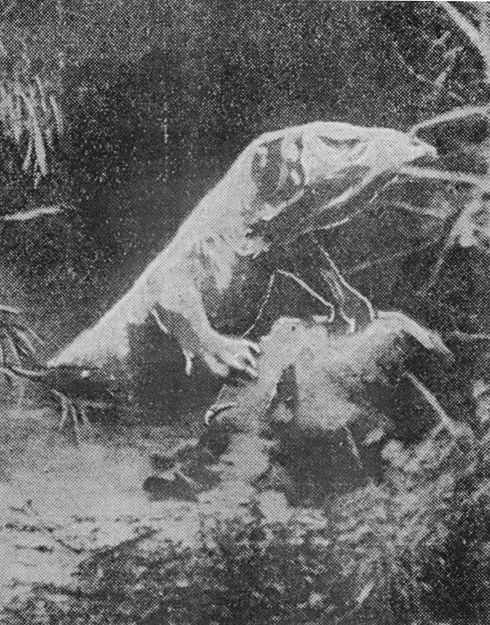
Figure 2. Photograph attributed to Johanson, showing the alleged ‘monster’ positioned atop a prey animal. Source: Heuvelmans (1995b), after the Rhodesia Herald.
A subsequent contact with Grobler further elaborated on his claims, during which he reaffirmed his conviction regarding the existence of a ‘giant lizard’ referred to as the ‘Chepekwé.’
‚„Chepekwe does exist“
Native stories of mystery monster
Secret told for a shilling
How natives in Northern Rhodesia accepted a shilling to tell him of the existence of the „Chepekwe,“ the monster mystery animal of the African swamps was described to-day by Mr. F. Grobler, the young big game hunter, to a representative of The Argus. Mr. Grobler’s story that „a huge leguan“ weighing four tons roams the Central African swamps attacking rhino, hippos and elephants has been supported by a Swedish hunter. Museum authorities are sceptical about the monster. To-day Mr. Grobler told how natives described the mystery animal to him. „It was during August last year, at Lake Bangweolo, Northern Rhodesia, that I first heard the natives talking about the animal they called ‚Chepekwe.‘ When I questioned them about it they would not say anything. But after a promise from me that I would give them a shilling, they told me this animal was living in water and fed on hippos and rhinos. I tried to find out more about it. But the natives were not anxious to tell me much. The natives in Central Africa have peculiar ways. They do not like telling the white man too much about anything, as he, the ‘Gwana,‘ only comes up to chase the game away and make it difficult for them to provide for their larder.
„Unlucky“
But for finding out what you want to know, trust your cook boy. That is, if you have a good one, and I must confess that I was then unlucky so, seeing I could not make any headway, I forgot all about this animal until after the Schomburgk expedition, when I returned to the Congo after elephants. The grass was so high that I decided to do some shooting on the Angola Flats. I had then secured a cook boy, Njapan, and one evening I heard him telling my gun boy and bearers round the camp fire about this huge monster Chepekwe he had seen in Lake Dilolo. So I immediately started to question him.
Fed at night
„He told me that this monster was seldom seen as it usually fed at night – when he makes his catch among the animals that come down to the lake to drink. Njapan told me that he knows only of two other natives who had seen this monster during the day. „My gun boy, Mpakali, told me that he had seen with his own eyes a huge piece of hippo flesh lying on the side of a pool at the Kasai River. Next to it was a tremendous spoor, similar to a crocodile‘s, but much larger. I am acquainted with the Kasai River. It is big and deep, and is infested with crocodiles and hippos. Natives are said to be very superstitious, and in some ways there are especially so about their dead. But I am perfectly satisfied that this „Chepekwe“ does exist, and that it is no ‚native imagination‘ as the local museum officials think. I shall now relate an experience that makes me believe in the ‚native talk,‘ especially when a hunter knows the native. The natives were always telling me about a big water snake which I had not seen. I did not attach much importance to it until one day, while fishing in the Luao, one of my boys told me to be very careful. One of these huge snakes, he said, lived in this place. After an hour’s fishing, a young native suddenly jumped up and ran away. He yelled as if he were being murdered. I got a scare and ran to the place where he had been sitting. I was just in time to see a huge snake swimming to the side of the water, where it disappeared in the long grass, hanging over the bank. I then decided to go and see the place where this Chepekwe was seen, and Njapan took me and showed me the place in Lake Dilolo. I found no trace of it, but I camped there. After three days I got blackwater, and was forced to return to Cape Town for my health. I am satisfied that the Chepekwe does exist, and it is a pity that these rare animals are discovered by outsiders first or overseas expeditions. They are interested – but not South Africans.“‘ (‚“Chepekwe does exist“, 1932).
— — —
The Rhodesia Herald, along with several international publications, began covering the combined story of Grobler and Johanson in mid-July 1932, seemingly using British United Press as its immediate source. This coverage already introduced a significant ambiguity: it referred to a photograph reproduced in a South African newspaper, showing the creature feeding on a dead hippopotamus, while also mentioning additional photographs sent by Johanson, in whose account the prey animal was identified as a rhinoceros. Thus, the confusion between hippopotamus and rhinoceros, as well as an apparent doubling of the photographic evidence, was already present in the early international transmission of the story. This coverage continued in abbreviated form until March 1933:
‘A mysterious monster of the Central African swamps, resembling a giant lizard and estimated to weigh four tons, is said to have been discovered in the Congo. The first story to reach South Africa of the strange beast came from a young big game hunter, Mr. F. Grobler, who went to the Dilolo Swamps in search of the monster. He failed to find it, but met natives who were convinced of its existence, so convinced that they have a name for it, „Chepekwe.“ […] What appears to be confirmation of his belief is a photograph which was reproduced in a South African newspaper which shows a huge lizard-like creature feeding off a dead hippopotamus in a swamp. Mr. Grobler (says the British United Press) has been acting as guide to the Schomburgk expedition. Major Schomburgk declared that if anything could induce him to return to the swamps it would be the prospect of finding the animal. Later a German newspaper received further photographs purporting to be of the chepekwe from a Swedish overseer at a rubber plantation in the Kassai district. The sender, J. C. Johanson, wrote that on 16 February last he went on a shooting trip. […] Suddenly he saw two elephants, and behind them a monster about 16 yards in length, with a lizard head and tail. He made three snaps with his camera, but only one picture came out well. The animal, he wrote, moved with astonishing rapidity. Very frightened, Johanson started back home, having to cross a big swamp. On his way he again saw the huge lizard, this time covered in ooze, devouring a dead rhinoceros. Museum officials in Capetown, however, believe that the chepekwe is merely the product of imagination. They point out that while there is no reason why there should not still be animals unknown to science, it is extremely unlikely that such an animal could exist in Africa for six months without scientists becoming aware of it.‘ (‚A 4-ton lizard‘, 1932; ‚Facts about the Chepekwe‘, 1932; ‚Giant lizard‘, 1932; ‚Monster Lizard of Central African Swamps‘, 1932; Mysterious monster seen in swamps‘, 1932; New swamp monster?‘, 1932).
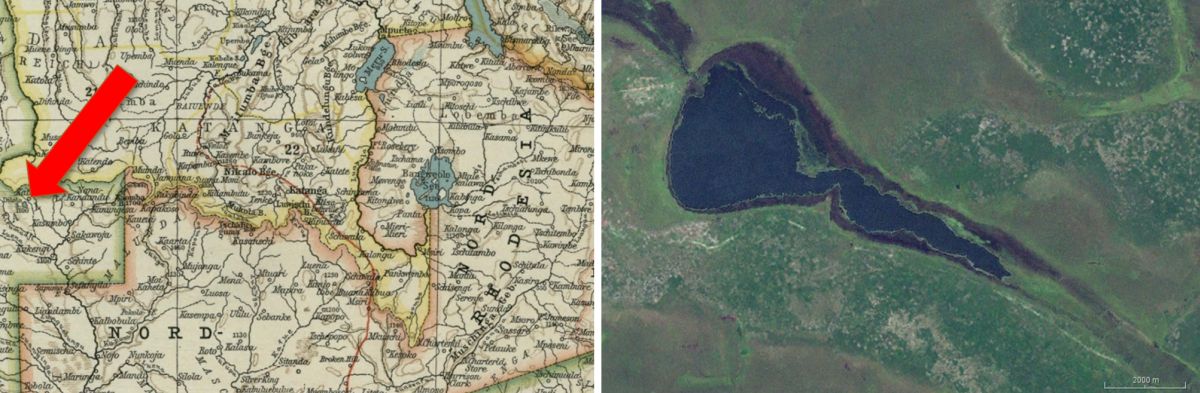
Figure 3. Left: Historical map detail showing the Lake Dilolo region. Source: Scobel (1921). Public domain. Right: Satellite image of Lake Dilolo, 2019. Source: Wikimedia Commons, Dilolo Lake.jpg; NASA World Wind public-domain layer. Public domain.
In February 1933, German newspapers likewise published adapted versions of the Cape Argus reports. These versions are examples of early conflation: they compress the Grobler and Johanson accounts, present Grobler almost as a direct witness, misattribute the photographic evidence to him, and replace Johanson’s rhinoceros with a hippopotamus:
‘Negroes are known to be endowed with a particularly strong imagination, and African wildlife, in particular, has repeatedly provided material for more or less fantastic myth-making by the natives. Among other things, the belief in the existence of enormous prehistoric giant animals is widespread in various regions of Africa, and the Cape Town newspaper „Argus“ has contributed further to these legends, which are quite interesting, even if researchers and big-game hunters flatly deny any factual basis. On the other hand, the witness for the Cape Town newspaper is an English big-game hunter, and a Swedish hunter also reported on such giant animals in the Belgian Congo in a German newspaper. The English hunter, a very well-known South African named Grobler, claims nothing less than to have encountered one of the dinosaurs of prehistoric times, a gigantic monster that, according to his estimate, weighs about 80 hundredweight and is found on the Dilolo Sill in Portuguese West Africa. This monster kills elephants, rhinos, and hippos, which is a testament to its impressive strength. The relevant museum authorities in South Africa were initially quite skeptical of Grobler’s report; however, Grobler has now submitted a photograph, which he was able to take with great difficulty. He emphasizes that the natives are well aware of this monster, known in their language as „Chepekwe.“ At the same time, Grobler submitted the report of the well-known German Africa hunter Schomburgk, who roamed the same regions and, although he never saw the giant beast, was familiar with the natives‘ accounts of the „Chepekwe“; he was fully convinced that there must be some truth behind these tales. Schomburgk wrote to Grobler that if he ever faced the dangers of an expedition to these eerie regions again, he would only do it to find „Chepekwe.“ The matter has become particularly topical now that a photograph of the giant animal has been discovered. It will likely become clear in the foreseeable future whether the whole thing is merely a clumsy attempt by Grobler to gain popularity, or whether further evidence can be provided. Meanwhile, a Swedish hunter, J. C. Johanson, who works on a rubber plantation in the Belgian Congo, reported an encounter with „Chepekwe“ in a letter to the „Kölnische Zeitung.“ He sent along several photographs, which, although very worn, were still sharp enough to clearly show a monster of enormous dimensions. The hunter had gone on a hunting trip to the Kassai Valley. However, no game was to be found. „Just as we were on our way down to the water,“ Johanson recounts, „the native porter drew my attention to two full-grown elephants hidden in the dense jungle. Barely fifty meters away, I was met with a sight I will probably never forget, something so improbable that I closed and opened my eyes again to convince myself I wasn’t dreaming: a gigantic animal, probably 16 meters long! My porter fell into the grass, mad with fear. The hunter’s fever seized me, but my teeth chattered with terror. With trembling hands, I managed to take three pictures, only one of which was reasonably clear. Suddenly, the giant animal disappeared with remarkable speed. It took several minutes for the initial shock to subside. My porter was still lying beside me, partly whimpering, partly invoking his pagan gods. I had to lift him up by force and drag him along with me. On the way home, we had to pass through a wide body of water teeming with hippos. Suddenly, the giant beast appeared again, this time with a dead hippo, from which it tore large chunks of flesh. I was petrified. The porter had run away with my rifle. At first, I was very careful not to move, then I remembered my camera. I could clearly hear the monster crunching the hippo bones with its sinister teeth. Just as I pressed the shutter button, the animal dived into the deep water. The tension was too much for me. Completely exhausted, I sank down behind the bush that had formed my hiding place. Everything went black before my eyes. The monster’s uncanny speed made me shudder. When I returned to camp, I must have looked quite distraught. A hunting friend later said that I staggered in all directions and made inarticulate noises. For eight days I lay with a high fever, mostly unconscious.‘ What should one believe? Reality or fantasy? In South Africa, people believe there must be some truth to these reports, while in Europe, experts dismiss them as pure fantasy. A Swedish researcher, Professor Lönnberg, commented on these reports that during his travels in the Kassai region, he often heard people speak of the giant beast, but no sane person believed any of it. The belief in living giant beasts is, incidentally, very widespread in various parts of Africa. He once heard from an English governor that the natives in the Victoria-Nyassa region claimed to have seen a huge python snake, which they considered a deity. In another region, the Negroes had convinced themselves that Johanson, from whom one report comes, had been seized by feverish delusions during his hunting trip; that was apparently the entire solution. It is very unlikely that dinosaurs could move so quickly. Big-game hunter Count Nils Gyldenstolpe also strongly doubts the veracity of the report. The giant beast fable is said to be very widespread in Africa. During his stay in Rwanda, there was much talk of an animal that was half goat and half leopard. European hunters and researchers had tried everything possible to establish the existence of such an animal, but one had never been seen. As for the alleged dinosaur, he said it was very likely that it was simply a large Varanus, a giant lizard that can grow to up to two and a half meters long. When he was in Siam in 1911, he shot such a monster. As magnificent and fantastic as the idea of suddenly rediscovering giant animals that we call „prehistoric“ and whose monstrous skeletons we only marvel at in museums is, our doubts must, of course, be strong in light of the conflicting statements. After all, dark Africa is still full of mysteries today, and we don’t know what else might emerge from it.‘ (‚Gibt es noch Dinosaurier?‘, 1933a-g)
— — —
Between 1933 and 1939, the accounts of Grobler and Johanson appeared intermittently in articles addressing reports of mysterious animals in Africa and elsewhere. These references were typically brief and provided no additional information, but stabilised the confusion between Grobler’s and Johanson’s account and the photographic evidence:
‘Mr. F. Grobler, a well-known South African hunter, brought such a queer tale to Capetown last year that he would probably never have told it without a photograph to support him. This was the story of the weird monster known among the natives of the Dilolo swamps in Angola as „chepekwe.“ „I think it is a member of the dinosaur family,“ Mr. Grobler told me. „Its weight would be about four tons and it attacks rhino, hippo and elephants. Hunters have heard the chepekwe devouring a dead rhino – crunching the bones and tearing out huge lumps of meat. It has the head and tail of a lizard. A German scientist has photographed it. I went to the swamps in search of it; but the natives told me it was extremely rare, and I could not locate the monster. Nevertheless I am convinced the chepekwe does exist. Here is the photograph.“ It was not a clear picture – photography in the primeval jungles of Africa is always difficult – but it revealed something new to science. Certainly it was not a crocodile. Most of the experts who joined in the subsequent controversy admitted that prehistoric animals might still linger in the remote swamps of the tropics.‘ (‚Mystery beasts still roam the wilds‘, 1933; Farmer, 1933; ‚Among the magazines‘, 1937; ‚Mermaids and monsters‘, 1937; ‚Mystery animals of the jungle‘, 1932; ‚Do mystery animals exist?‘, 1938; Green, n.d.; ‚Mystery animals‘, 1939).
— — —
The biologist Ivan T. Sanderson repeatedly discussed the possibility of so-called ‘neodinosaurs’—a term he used for alleged surviving dinosaur-like or otherwise prehistoric reptiles—in Africa (1948; reprinted 1969, 1979, 2007), incorporating the Grobler case as reported in the Cape Argus and the Rhodesia Herald. In doing so, he reproduced a brief version of Grobler’s statement:
‘A well-known South African big-game hunter, delighting in the name of Mr. F. Gobler, returned from a trip to Angola and announced to the Capetown newspaper, the Cape Argus, that there was an animal of large dimensions, the description of which could only fit a dinosaur, dwelling in the Djilolo Swamps, and well known to the natives as the ‘chipekwe’. He stated: ‘Its weight would be about four tons and it attacks rhino, hippo and elephants. Hunters have heard a chipekwe—at night—devouring a dead rhino, crushing the bones and tearing out huge lumps of meat. It has the head and tail of a lizard. A German scientist has photographed it. I went to the swamps in search of it, but the natives told me it was extremely rare, and I could not locate the monster. Nevertheless, I am convinced the chipekwe does exist. Here is the photograph.’’
Although Sanderson introduced this material as part of what might be regarded as the ‘lunatic fringe’ of neodinosaur accounts, he nevertheless emphasised what he described as a ‘terrific outburst in the editorial and correspondence columns of the paper’, adding that ‘the astonishing thing is that the majority of the experts, both scientific and sporting, and all with much local knowledge, agreed that it might exist.’
Notably, however, Sanderson did not engage directly with the original Cape Argus article, which presented Grobler’s statement as an interview, but instead cited as his immediate source a ‘letter to the editor’ that has not yet been identified. His reliance on this indirect or insufficiently specified source base may account for several inaccuracies in his version of the report, including the misspelling of Grobler’s name and Lake Dilolo. It is also striking that Sanderson did not comment on the appearance of the published photograph: as a zoologist, he might have been expected to recognise the reptilian figure as a Komodo dragon or at least as a monitor lizard. Moreover, neither the purported ‘terrific outburst in the editorial and correspondence columns’ nor the claim that ‘the majority of the experts, both scientific and sporting, and all with much local knowledge, agreed that it might exist’ has thus far been substantiated. At present, the only known supportive example is a letter to the editor of the Cape Argus by an anonymous writer claiming to be a student of palaeontology, who argued in favour of the neodinosaur interpretation. If anything, the available contemporary evidence suggests that local scientists tended to be sceptical of (neo-)dinosaur claims (Loxton & Prothero, 2013; ‘Met the mystery monster’, 1932).
— — —
The German zoologist Ingo Krumbiegel (1950) discussed these reports under the title ‘Löwe des Wassers’ (‘Lion of the Water’), drawing on accounts by Schomburgk, Nolde, and others. Referring to Sanderson (1948), he noted that the South African big-game hunter ‘Cobler’ had submitted a report to the Cape Town newspaper ‘Cap Argus’ concerning a gigantic creature said to inhabit the Dilolo swamps (eastern Angola). According to this account, the animal was said to weigh approximately four tons and to attack hippopotamuses, rhinoceroses, and elephants, while local populations reportedly referred to it as ‘Chipekwe’.
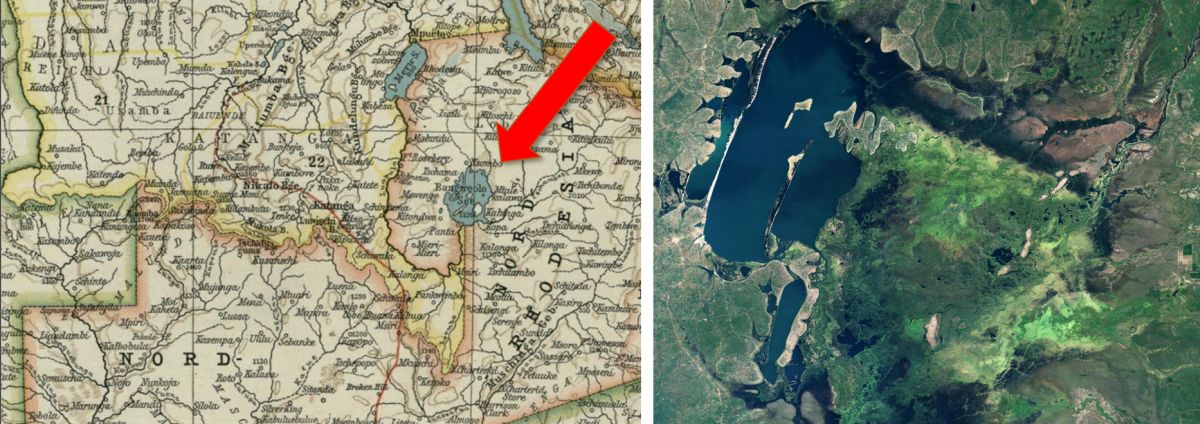
Figure 4. Left: Historical map detail showing Lake Bangweolo. Source: Scobel (1921). Public domain. Right: Satellite image of Lake Bangweolo and its surrounding wetlands. Source: Wikimedia Commons, Lake Bangweulu.jpg; public-domain satellite imagery. Public domain.
At the same time, Krumbiegel’s further discussion strongly suggests that he had recognised a version of the Johanson photograph and report as fraudulent five years before Heuvelmans. Since he did not provide source references, the identification of the account he had in mind cannot be established with certainty. Nevertheless, the close correspondence in content makes it highly plausible that his remarks refer to the illustrated newspaper version identified in this article: ‘In recent years, an illustrated magazine published a sensational account from “eyewitnesses” who claimed to have even seen and photographed the uncanny creature: the photos were a highly regrettable mystification. It was easy for a zoologist to see that a (not even well) stuffed monitor lizard, a larger species of lizard, had been pasted into the landscape, pretending to be a giant animal.’ Heuvelmans (1978) himself evidently understood Krumbiegel’s remark in this sense. Immediately after quoting him, he commented that, among other things, ‘one will have recognised’ the photograph allegedly taken in the Kasai by the foreman Johanson and exhibited by Franz Grobler in support of his own story.
— — —
(Crypto-)zoologist Bernard Heuvelmans (1955) noted that ‘different and sometimes contradictory versions of Grobler’s story were printed in different newspapers’. In attempting to trace the origins of the account, he reported that he had been unable to locate the alleged publication in the Cologne Gazette (Kölnische Zeitung), and questioned whether the report had appeared there at all.
With regard to the accompanying photograph, Heuvelmans suggested that it was ‘presumably the one taken by the Swede and referred to by Grobler’, while pointing out discrepancies in the description of the prey: ‘one says the beast it is eating is a rhinoceros and the other a hippopotamus’. He further emphasised that ‘the photo itself is so indistinct that one cannot possibly recognise the monster’s prey’, before concluding that the image was ‘a crude fake’. In his explanation, ‘a Komodo dragon has been transplanted […] on the carcass of a hippopotamus or rhinoceros’, and this ‘faked evidence is enough to destroy any remaining belief in the truth of Johanson’s story’.
Heuvelmans acknowledged that Grobler had also drawn on earlier reports associated with Hans Hermann Schomburgk, noting that ‘fact and fiction were closely intermixed’. He argued that Schomburgk had already referred to the ‘chepekwe’ in the early twentieth century and that Grobler had subsequently ‘confuse[d] and embroider[ed] the facts’, mistakenly treating Johanson’s letter and photograph as confirmation.
— — —
The journalist and author Daniel Cohen (1970) briefly treated the case as an African dinosaur hoax, evidently drawing on Heuvelmans’ interpretation. He described the photograph as a poor composite in which an ordinary lizard had been superimposed onto an African background in order to appear enormous. At the same time, Cohen suggested that the hoax may have drawn on a vague Central African tradition concerning large, lizard-like animals, geographically widespread, imprecise, and known under different names.
— — —
In his 1978 study Les derniers dragons d’Afrique (‘The Last Dragons of Africa’), Bernard Heuvelmans expanded his previous discussion of the Grobler–Johanson case, this time drawing explicitly on the earlier Cape Argus reports. Referring to Hans Hermann Schomburgk (1936), he confirmed that a Boer (South African of Dutch descent) named Franz Grobler had participated in the 1931/1932 expedition as a truck driver, and that Schomburgk himself had collected accounts of a creature referred to as the ‘Chimpekwe’.
As in his earlier work, however, Heuvelmans was unable to locate the alleged original newspaper report by Johanson in the Kölnische Zeitung, which would have allowed verification of the photograph. After examining issues from the first half of 1932, he concluded that the Kölnische Zeitung was unlikely to have been the source, noting that ‘this newspaper published photos only very exceptionally’, and then primarily portraits. Nevertheless, he argued that ‘everything […] suggests that it was the one taken by Johanson’, while drawing attention to discrepancies in the various published accounts:
‘Johanson had supposedly photographed the giant lizard while it was devouring a rhinoceros, while Franz Grobler claimed to have seen a photo of a Chepekwe ‘standing on the back of a hippo.’ It was, moreover, this version that the Cape Argus took issue with, since, in the caption of the photograph, it spoke of a ‘monstrous lizard feeding on a dead hippopotamus.’ It must be said that the photograph is so poor that it is hardly possible to distinguish the identity of the prey. It is obviously regrettable that Grobler never revealed the exact circumstances under which he had seen the photos depicting the Chepekwe. One might also wonder why on earth he claimed that it had been discovered six months earlier ‘by a German scientist,’ when it was actually a simple Swedish foreman. Or did he mean to refer to Schomburgk himself in this way? But then, why not have said so?’
He concluded unequivocally:
‘Whether the Chepekwe exists or not, one thing cannot be doubted: the photo published in the Cape Argus, and reprinted shortly thereafter in the Rhodesia Herald, is a crude fake. It shows a Komodo dragon, introduced not without technical clumsiness into an African marsh setting, performing on pointe, with the grace of a ballerina, on the corpse of a rhinoceros or a hippopotamus, for the sole purpose of appearing enormous. If anyone still had the slightest illusion about the truth of Johanson’s incredible tale, this ‘document’ should have dispelled it. Once again, the affair ended in a damp squib.’
In this discussion, Heuvelmans acknowledged that ‘reality and fiction are closely intertwined’, and that ‘the jokers [had] been inspired by rumours based on authentic facts’. He attributed a key role to Schomburgk, arguing that it was he who had first introduced Grobler to accounts of the ‘Chimpekwé’ or ‘Chepekwé’. Grobler, in turn, was said to have conflated and embellished the facts, interpreting Johanson’s photographs as confirmation of reports derived both from Schomburgk and from local informants. In his later synthesis, however, Heuvelmans also counted the Grobler report itself among the fallacious accounts, treating it as dependent on the Johanson material rather than as independent evidence.
— — —
In the decades that followed, numerous publications revisited and reinterpreted the Grobler and Johanson accounts. The content and emphasis of these works varied considerably, depending on their format and the perspectives of their authors. Some explicitly identified both reports as hoaxes, or at least presented them in a sceptical light (Man, 1978; Eberhart, 2002), while others classified only the Johanson account as fraudulent (Akimuschkin, 1963; Newton, 1979) or incorporated it without further comment (Farson & Hall, 1978; Clarke, 1981), whereas certain authors focused exclusively on the Grobler case without addressing the Johanson report (Welfare and Fairley, 1981; Bright, 1987).
— — —
Although Gino D’Achille worked across a wide range of subjects, he is best known for his book and magazine covers, particularly within pulp and adventure literature, including the John Carter of Mars series by Edgar Rice Burroughs. He also produced several illustrations for works by Angus Hall (Farson & Hall, 1978; Hall, 1975), among them depictions such as a (plesiosaur-like) ‘Nessie’ carrying a lamb in its jaws (a reference to the Spicer report of July 1933), or two imposing yetis observed by a group of men (based on accounts from The Long Walk (1956)).
In a chapter addressing the possibility of surviving dinosaurs, D’Achille illustrated the second sighting attributed to Johanson and his companion (Figure 5). The resulting painting depicts a theropod-like dinosaur positioned over a severely injured and bleeding rhinoceros in a swampy environment. In the background, partially concealed by vegetation, Johanson is shown observing the scene, while his companion appears to turn away, seemingly on the verge of flight.
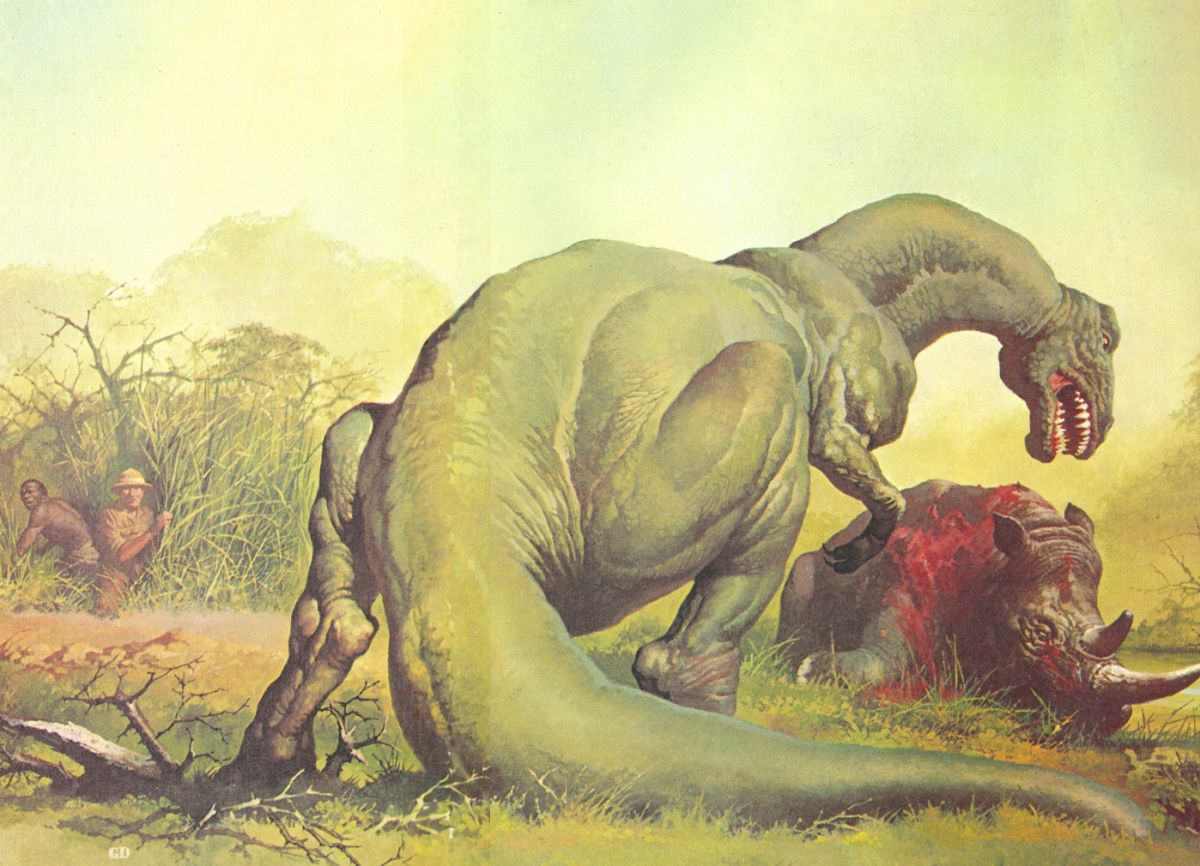
Figure 5. Illustration by Gino D’Achille depicting a theropod-like creature over a rhinoceros in a swamp setting. Source: D’Achille, in Farson and Hall, Geheimnisvolle Wesen und Ungeheuer (1978). Two-page reproduction digitally joined and lightly retouched to reduce the visible book fold. Courtesy of: Studio D’Achille.
Although D’Achille was not a specialised palaeoartist and worked across a broad range of subjects—circumstances that may account for certain anatomical and physiological inaccuracies—the depicted creature remains readily identifiable as a theropod. His illustration constitutes one of the earliest and most elaborate visual representations of the creature described in the Johanson account in this form and may have contributed significantly to the later development of the so-called ‘Kasai Rex’ motif.
— — —
At an as yet unverified point, seemingly around the year 2000, the pop-cultural phenomenon of the so-called ‘Kasai Rex’ emerged in the form of a theropod dinosaur, prominently modelled on Tyrannosaurus rex. This reimagining generated considerable attention across a range of media, including comics, television productions, online videos, fictional literature, and numerous illustrations, and continues to do so to the present day. Although inspired by the Johanson account, these ‘Kasai Rex’ tales represent a substantial departure from the historical report, incorporating misinterpretations, embellishments, and entirely fabricated elements. Even within the older prehistoric-survivor paradigm (Naish, 2006) of zoologically framed cryptozoology, the specifically Tyrannosaurus rex-like reconstruction is problematic: it is absent from the original account and palaeozoologically incongruous, since T. rex is not known from Africa. Later attempts to substitute African theropods for T. rex likewise do not resolve this historically, since they also represent retrospective reinterpretations rather than elements of the 1932 account.
However, the theropod framing did not emerge entirely without precedent. An even earlier example of this interpretative tradition, predating also D’Achille’s illustration, appeared in an issue of Le Journal de Tintin, a Franco-Belgian weekly youth and comics magazine. The article, titled À la recherche du Monde perdu (1955), retold a ‘Gobler’/’Chipekwe’ episode within a cryptozoological ‘lost world’ framework. Particularly revealing is an image accompanying the article: placed next to an outdated, kangaroo-like reconstruction of T. rex, the caption asked whether the Chipekwe of the Dilolo swamps might itself be a tyrannosaur. This shows that the report was already being interpreted through an explicitly theropod frame at least in a mid-twentieth-century popular magazine context.
Later ‘Kasai Rex’ retellings developed this embellished association into a far more elaborate narrative complex, as the following example illustrates:
‘In the heart of Africa, to the amazement of many, there have been sightings of Tyrannosaur-like creatures—one, in particular, by a plantation owner, John Johnson, and his slave. As the report goes, Mr. Johnson and his African slave were traveling through a swampy marsh in the Kasai valley in 1932. Suddenly, they came across a rhinoceros, and were cautious not to disturb it. Then, to their immediate horror, a large, 42 foot (13 meter) long ‘lizard’ leaped out of the trees and attacked the rhino. […] It was a large beast, at least 12–13 meters long. It was reddish in coloration, with brackish-colored stripes […] It gorged itself on the rhinoceros […] After the creature had eaten its fill, it returned to the jungle slowly, its belly full of flesh’ (Kasai Rex, n.d.-a).
In addition to such retellings, further fictional stories have emerged, including accounts of a purported 1951 expedition led by ‘Robert Henderson’, allegedly ending in the massacre of its participants (Kasai Rex, 2026; Lopez Luna, 2023). While many of these accounts are explicitly framed as entertainment—or can readily be identified as such—their widespread circulation has nevertheless led to confusion among some authors attempting to interpret the broader body of material associated with the ‘Kasai Rex’ (e.g. Kasai Rex, 2026).
A similar dynamic can be observed in the visual domain. Among the numerous illustrations and manipulated images circulating online, some have attracted particular attention. One such example, which appeared online around 2007, depicts a ‘Kasai Rex’ feeding on a rhinoceros. As noted by Shuker (2016), the image was created by a known digital artist (‘Finbar’), who openly acknowledged that it was a composite produced by superimposing a model of Allosaurus onto a photograph of a rhinoceros.
A second image (Figure 6), showing a striped reptilian creature with its jaws open in front of dense vegetation, has likewise been circulated as the alleged ‘original photograph’ taken by Johanson (Kasai Rex, 2025b-c; 2026). This attribution, however, is also demonstrably unfounded. The image appears to have originated within a fan-based digital environment, specifically a website associated with a role-playing game, where it was presented in the form of a digitally altered Rhodesia Herald clipping, into which both the Johanson account and the manipulated image had been inserted. Reverse image search and comparison show that the underlying photograph (Figure 6) depicts a Komodo dragon and was subsequently subjected to digital modification.
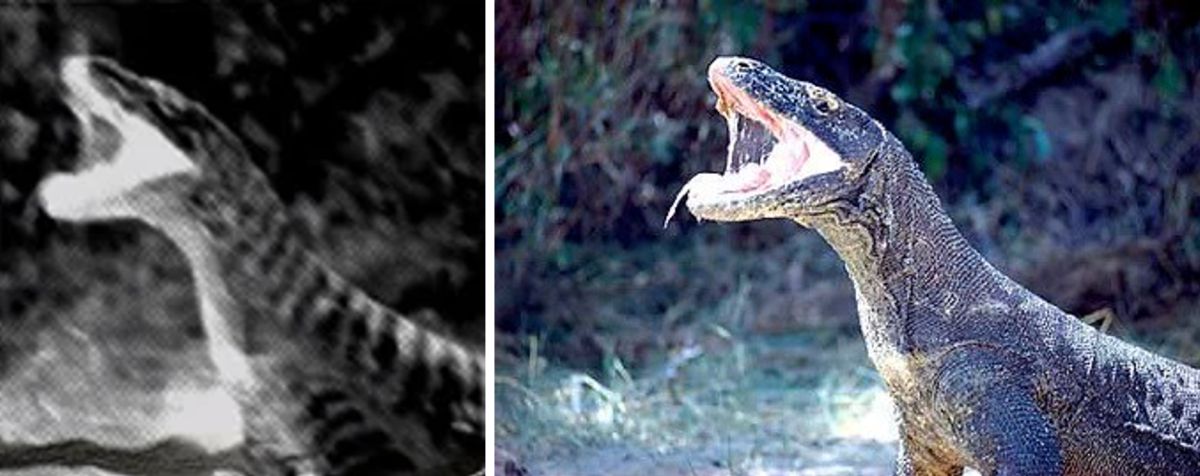
Figure 6. Left: Manipulated image circulated as the supposed ‘original’ Johanson photograph. Right: Matching Komodo dragon photograph, used as the source for the reptilian figure; the earliest source of this photograph has not yet been identified. Sources: left: Stanton (2012); right: Jura (2009), with the image credited there to Baxterking.com.
Taken together, these textual and visual developments illustrate a shift from a supposedly scientifically grounded cryptid to a pop-cultural cryptid (Hill, 2024).
— — —
In 2016, Karl P. N. Shuker examined the Johanson account and reviewed the origins of its later interpretation as a dinosaur. He emphasised that ‘nowhere in his letter did Johanson actually refer to the supposed giant reptile as a dinosaur, merely as a huge lizard’, acknowledging that the subsequent classification of the creature as a dinosaur derived not from the original report itself, but from an editorial addition accompanying its publication. As Shuker noted, this comment, attributed to a member of the newspaper’s staff, stated that ‘Johanson stumbled upon a unique specimen of a dinosaur family that must have lived millenniums [sic] ago’.
At the same time, Shuker adopted the contemporary pop-cultural term ‘Kasai Rex’ in both the title and body of his discussion and pointed to further internal inconsistencies, observing that ‘tellingly, Johanson made no mention of any local name for this spectacular creature, despite being accompanied by a native helper’, whose community, if such an animal had existed, ‘would therefore have certainly given its species its own local name’. For Shuker, this absence constituted ‘another clue [that] the entire story is just that, a work of fiction’.
He further addressed the emergence of additional descriptive details frequently associated with the ‘Kasai Rex’, noting that ‘various websites claim that Johanson later stated that the monster was reddish in colour with blackish stripes […] and that he had decided that it was a Tyrannosaurus’. However, Shuker emphasised that ‘no original sources for these additional comments claimed for Johanson are given’, and that such elements were absent from earlier treatments of the case, including those by Bernard Heuvelmans.
Case examination
It is noted in the Cape Argus that Franz Grobler served as a guide for the Schomburgk expedition of 1931/1932 to Angola and the Dilolo swamps, which aimed, among other objectives, to obtain film footage of the so-called ‘Chepekwé’. In addition, a clipping from a German newspaper accompanied the photograph attributed to Johanson that had been submitted to the Cape Argus. This report stated that Schomburgk, during lecture tours in Germany, had referred to local traditions concerning a large reptilian creature inhabiting Central African swamps. As the following analysis demonstrates, the origins of the case can indeed be traced to Schomburgk’s activities, which provided an important source of inspiration for the later hoax and a contextual frame for Grobler’s subsequent statements.
For the purposes of this analysis, the discussion is restricted to the ‘Chimpekwe’ context relevant to Schomburgk, Grobler, and the Johanson report, drawing on German- and English-language sources where they bear directly on the transmission of the case. It does not attempt to reconstruct the wider ‘Chepekwe’ complex or later speculative attempts to attach the name to distinct regional traditions and cryptid types, including supposed ‘water rhinoceros’ traditions, comparisons with ‘Emela-Ntauka’, and similar later identifications. The ‘water lion’ complex is addressed only where it bears directly on Grobler’s terminology or Heuvelmans’ later treatment of some ‘Chimpekwe’ reports. Within this narrower frame, a Batwa report preserved by Schomburgk is also included, since it appears to have been overlooked in later treatments and provides the only comparatively detailed anatomical description attached to the name variant ‘Chipikwe’ in Schomburgk’s account.
Schomburgk, the ‘Chimpekwe’, and the ‘Great Africa Expedition’
The following section therefore reconstructs Schomburgk’s engagement with the ‘Chimpekwe’ in some detail and on two levels. First, it considers the material that was available to the German public and press before the publication of the Johanson report in 1932 and thus formed part of the background from which the hoax could draw. Second, it examines later information that may have circulated within the expedition itself and could therefore have shaped Grobler’s later account. Unless otherwise indicated, this reconstruction is based primarily on Schomburgk’s works of 1910, 1934, and 1936.
Hans Hermann Schomburgk (Figure 7) was born 1880 in Hamburg, Germany. From 1898 onwards, he undertook a series of voyages across Africa, occupying a range of professional roles. His career encompassed service in the Natal Mounted Police as well as in the local police force of Barotseland, employment as an elephant hunter—later transitioning into an advocate of animal welfare—and work as a topographer. He is, however, most prominently recognised as an explorer and filmmaker. Upon his return to Germany, he established himself as a lecturer and author, disseminating accounts of his experiences (Baldus, 2014; ‘Biografie Hans Hermann Schomburgk 1890–1967’, n.d.; Schomburgk, 1910, 1936).
Within the history of zoological collecting, Schomburgk is particularly noted for his activities as a collector and procurer for the Hamburg-based animal trader Carl Hagenbeck (1844–1913). In this capacity, he achieved particular prominence in 1912 by successfully transporting live pygmy hippopotamuses (Choeropsis liberiensis) from Liberia to Germany (Schomburgk, 1922).
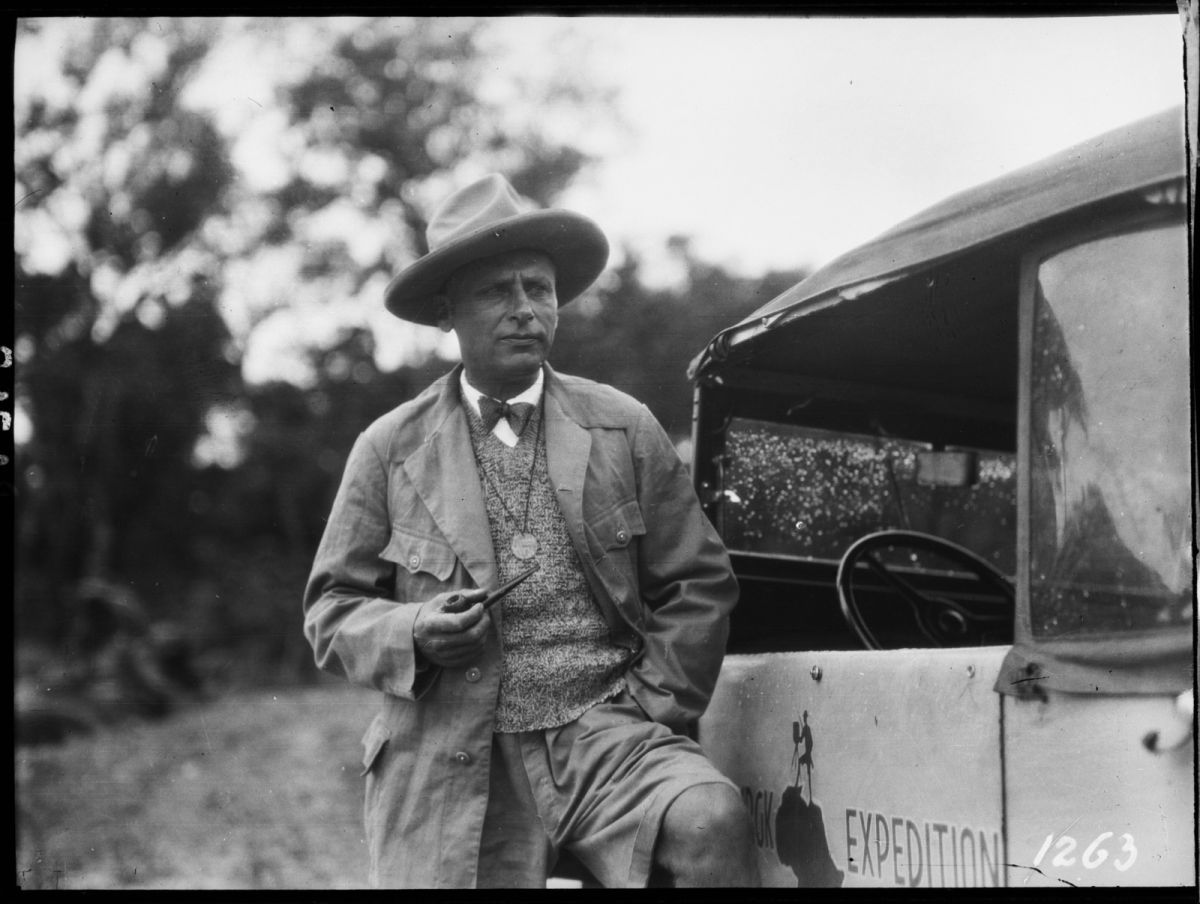
Figure 7. Hans Hermann Schomburgk beside one of the expedition vehicles. The car bears the expedition emblem: a silhouette of Africa surmounted by a film camera and cameraman, with the inscription ‘Schomburgk Expedition’ appearing to the left and right of the emblem. Courtesy of: © Deutsche Fotothek / Unbekannter Fotograf.
— — —
Schomburgk first reached Lake Bangweolo (then Northern Rhodesia, today Zambia) on 31 July 1907, arriving from the west, and departed on 9 September 1907 after conducting exploration in the region. His observation that hippopotamuses appeared to be largely absent from the lake later attracted considerable attention. He suggested that this might be explained, at least for the western shore, by sandy banks unsuitable for hippos, despite their presence in comparable riverine environments. By contrast, the eastern and southern margins of the lake consisted of extensive swamp systems that, in his estimation, should have provided ideal habitat, yet hippopotamuses were reportedly seldom observed there.
As an explanation for their apparent absence, local informants told Schomburgk that an animal lived in the lake, smaller than a hippopotamus but feeding exclusively on them. This creature was said never to leave the water and to leave no observable traces, implying a fully aquatic mode of life. The apparent contradiction in Schomburgk’s description—between an ‘amphibious’ animal and one that never came ashore—has been interpreted by Heuvelmans (1978) as indicating an organism that, while not a fish, was nonetheless entirely aquatic. At the time, however, Schomburgk (1957) regarded these reports as local myth and did not pursue them further, particularly as the name of the creature was not repeated and subsequent inquiries were reportedly evaded.
Schomburgk stated that hippopotamuses had not been ‘hunted out’ at Lake Bangweolo—apparently meaning that their scarcity was not the result of severe reduction through hunting with firearms. This claim should be treated with caution. As far as can be established, the possible effects of local hunting practices, colonial travel, firearm hunting by Europeans or colonial personnel, expeditionary provisioning, armed conflict, and wider transport and supply networks have not been systematically assessed for the Bangweolo region. Although the available evidence is fragmentary, it nevertheless shows that hunting pressure in a broader sense cannot simply be excluded. The 1911–1912 Swedish Rhodesia-Congo Expedition explicitly describes hippopotamus hunting among the Batwa of the Bangweolo swamps, including the use of a harpoon with line and float (von Rosen, 1916). Campbell (1922) likewise refers to hippopotamus hunting with harpoons, the economic value of hippo meat, fat, hides, and ivory, and describes joining a canoe-based hippo hunt within the Lake Bangweulu system. Although this evidence postdates Schomburgk’s first visit by several years, it demonstrates that hippopotamus hunting was practised in the region and suggests that Schomburgk’s statement may have been too categorical and insufficiently documented. Later local assessments likewise point to hunting pressure as a factor affecting the population: Huchzermayer (2012) noted that the Bangweulu population had been heavily hunted in ‘past decades’, although the exact period intended by this statement remains unclear.
This broader uncertainty over the causes of hippopotamus scarcity is also relevant to Heuvelmans’ (1978) later discussion of the wider Bangweolo context. Referring to a 1966 report of only six hippopotamuses observed during several months in the region, he suggested that this might indicate ‘abnormal adverse conditions’, or that such conditions had formerly prevailed there for a long time. He did not specify the nature of these conditions, which could in principle include hunting pressure, whether for subsistence, trade, provisioning, or conflict-related reasons, as well as ecological constraints or other factors affecting the suitability of the region as hippopotamus habitat. As far as can be established, however, no subsequent cryptozoological discussions offered a systematic environmental-historical assessment of this question; existing treatments have largely remained limited to the question of species presence alone.
While Ley (1948) and Heuvelmans (1958; revised 1978) erroneously assumed the absence of hippopotamuses, Schomburgk himself had already confirmed their presence (1910), later specifying small populations along the western shore and an apparent absence within the eastern marshes (Schomburgk, 1957). Early twentieth-century accounts likewise suggest a comparatively low hippopotamus density and a spatially uneven distribution within the Bangweolo system, although these observations are not based on systematic surveys but on the convergence of individual reports. Melland (1911) noted that hippopotamuses were present but ‘not numerous’, associating them chiefly with open water and larger riverine channels within the wider Bangweolo system rather than with the swamp area inhabited by the Wa-Unga (one of the local population groups of the Bangweolo swamps). Schomburgk’s observations are consistent with this pattern, while Hughes (1921), drawing on long-term experience from 1902 to 1919, offered the general assessment that ‘hippopotami are not numerous in the swamps’. Despite their differing methodological bases, these sources indicate presence at low densities without allowing precise population-level quantification. Later observations, including the 1966 report cited by Heuvelmans, suggest that this pattern may have persisted, although they belong to a different historical context and cannot be projected back directly onto Schomburgk’s period. While Huchzermayer (2012) indicates that historically ‘many more’ hippos inhabited the wetlands, more recent data point to lower numbers: according to Chomba et al. (2013), approximately 100 individuals were recorded at the lake in 2003, with only occasional movement into the surrounding swamps (Bangweulu Wetlands Zambia, 2015).
— — —
It was only after his contact with Hagenbeck that Schomburgk began to take the ‘Chimpekwe’ reports more seriously. Hagenbeck interpreted such accounts as possible evidence of surviving dinosaurs, an idea he elaborated in his 1908 publication Von Tieren und Menschen (Beasts and Men). According to Hagenbeck, rock and cave paintings in Rhodesia, together with reports from one of his travellers and an Englishman, described a creature ‘half elephant, half dragon’ inhabiting swamp regions. These accounts were said to align with earlier statements by his traveller Joseph Menges, who had reported a similar animal. On the basis of what he regarded as consistent testimonies from multiple sources, Hagenbeck concluded that the creature could represent a surviving form of Brontosaurus. At an unspecified earlier date, he reportedly dispatched an expedition to the region—identified by Schomburgk (1910) as Lake Bangweolo—which ultimately failed owing to illness and hostile encounters with local populations.
Owing to Hagenbeck’s international prominence, the account received widespread attention, while critical assessments by local Rhodesian scientists were largely disregarded (Loxton & Prothero, 2013). Hagenbeck’s own position, however, remains only briefly documented and leaves several questions unresolved. The first concerns the alleged visual evidence. Although rock and cave paintings from Northern Rhodesia have been associated with neodinosaur interpretations (Mackal, 1987), no direct link to Hagenbeck can be established. It therefore remains uncertain whether he—or his informants—misinterpreted this imagery in a comparable manner (Senter, 2012), or whether entirely different visual sources were intended.
Similarly, the identity of Hagenbeck’s reported and unnamed ‘traveller’ remains unresolved. Contrary to earlier assumptions (Heuvelmans, 1978; Mackal, 1987; Clark, 1993), Schomburgk himself cannot be identified as this informant on chronological grounds. His first documented contact with Hagenbeck dates to 1909, when he facilitated, through intermediaries, the sale of a young elephant from Dar es Salaam, Tanzania (Schomburgk, 1934), followed by a personal meeting in early 1910 (Schomburgk, 1910). Only after this encounter did he undertake occasional freelance work for Hagenbeck. Prior to that, there is no evidence of regular contact or any obligation to report, as would typically be expected within a formal employment relationship.
— — —
In the years following his return to Germany, Schomburgk undertook further expeditions, including film projects in Liberia and Togo, served during the First World War, and engaged in lecture tours (‘Biografie Hans Hermann Schomburgk 1890–1967’, n.d.). It was not until his eighth African expedition in 1931/1932—his second visit to Lake Bangweolo—that he was able to engage more directly with reports concerning the ‘Chimpekwe’. This expedition, its aims, and its underlying motivations were subsequently outlined in contemporary German press reports:
,On May 29, the scientific African expedition, which had been quietly prepared for months, set off from Hamburg to Angola under the leadership of the renowned African explorer Hans Schomburgk […]. Among the eight participants of the financially and technically well-equipped expedition were, in addition to the explorer’s wife, a Swiss zoologist [Dr Berta Coninx-Geradet (Schomburgk, 1934)], the zoologist Dr. Haas [specialised in malacology] from the Senkenberg Institute in Frankfurt am Main, and a geologist; also the Berlin cameraman Paul Lieberenz, well-known for his participation in a series of important major research expeditions, and an engineer from the Opel factory, which provided the expedition with two cars and two trucks. In addition to solving the scientific tasks, the expedition program includes the shooting of a large-scale sound film under Schomburgk’s personal direction. For this special purpose, in addition to the unknown northwestern stretch of Angola, rich in wildlife, the enigmatic Lake Bangweolo, where Schomburgk suspects the existence of a legendary dinosaur, and other unexplored areas will be visited. […] Schomburgk’s third African crossing will take him from Angola (Lobito) to Durban (Natal), taking many detours through completely unexplored areas. The route, to be completed in about 10 months, is approximately 10,000 kilometers, roughly the distance from the Cape of Good Hope to Cairo’. (‚Schomburgks Start zu seiner dritten Afrikadurchquerung‘, 1931; Meine Freunde im Busch, 1936). Of course, the search for a supposed living dinosaur was highlighted more extensively, including a brief reference to Schomburgk’s and Hagenbeck’s previously discussed views: ‘In recent years, a clever English film, „Lost World,“ vividly portrayed the elemental life of prehistoric animals, those gigantic saurians and dinosaurs, in vivid images. Many people were struck by the idea of the bizarre and adventurous consequences that the appearance of such a monster (which, like most dinosaurs, as herbivores, could hardly pose a threat to humans) on today’s Earth would have. Interestingly, these fantasies, which found their most colorful expression in adventure books, such as Maders novels, are the accounts of various travelers. What is certain is that swampy regions, which in terms of temperature, inaccessibility, and thus untouched by humans and vegetation, resemble the landscapes of the Tertiary and similar epochs, could theoretically still offer the large reptiles a living existence today. Such regions would include the still completely unknown river basins of the southern Amazon and certain areas of Central Africa, inaccessible to white people due to vast swamps, which Hans Schomburgk is currently embarking on with his new expedition. The only suitable observers for such regions would be the natives. Inspired by cave drawings from within Africa and by reports from the Negroes, the creator of the Stellingen Zoo, Carl Hagenbeck, sent a medium-sized expedition to Africa shortly before the war with the bold goal of capturing the „great beast“ of the cave walls or at least scientifically identifying it. The sensational possibility of seeing a real dinosaur in the Stellingen enclosures was, however, thwarted by the expedition’s heavy losses from fever and swamp sickness, as well as in material. The attempt by a sober-minded man of action like Hagenbeck to take steps in this direction is significant, as they were unfortunately never taken again. […] The fact that for many years to come, animals previously unknown to us will continue to be discovered in African regions – one thinks of Schomburgks pygmy hippos and others – and the certainty that large areas of the Dark Continent have never seen a white man and can only be explored by airplane, supports the theory of prehistoric animals on the Earth today’. (‚Vorwelttiere auf der heutigen Erde., 1931a-b; Vorwelttiere auf der heutigen Erde?‘ 1931).
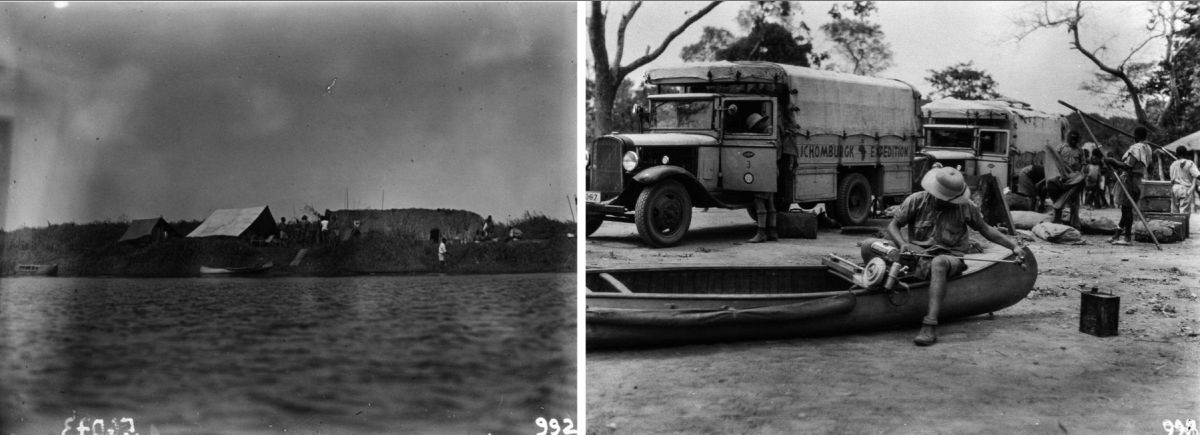
Figure 8. Left: Expedition camp at Nsombo. Right: Camp scene with two trucks in the background and an expedition member in a canoe in the foreground. Courtesy of: © Deutsche Fotothek / Unbekannter Fotograf.
The most interesting expedition member for the purposes of this article, aside from Schomburgk, was the young Franz Grobler, who was only hired in July 1931, when the expedition reached its second stop in Durban. He was not engaged as a guide or big-game hunter, as has sometimes been stated—although he did participate in hunting for provisions—but served instead as the driver of the second truck. According to Schomburgk, Grobler was ‘the typical Trekboer’ (a semi-nomadic Afrikaner farmer accustomed to a practical life), ‘who had spent his whole life with ox-wagons and later with trucks.’ Although he proved well suited to his duties, some members of the expedition, especially the scientific participants and the engineer, found him difficult to work with, whereas Schomburgk knew how to handle him.
As the expedition proceeded inland, it eventually reached the village of Nsombo (Figure 8), situated north of Lake Bangweolo, in October 1931, where it established its principal base for further exploration of the region (Figure 9). During his stay, Hans Hermann Schomburgk encountered an old Scottish acquaintance, David Roß, who subsequently joined him on an excursion around the lake and through the surrounding marshlands, beginning on 24 October.
While camped on Chilubi Island, the two men reminisced about earlier experiences, during which Schomburgk cautiously directed the conversation ‘to the legendary beast, the monster, that is said to inhabit Lake Bangweolo and of which I had already heard in 1907:’:
I had discussed this topic in Fort Jameson [today the city of Chipata] with Mr Sandfordt [corrected in Schomburgk’s 1936 account to Sandford; later rendered as Sandford or Stanford of Fort Jameson; possibly T. F. Sandford, a colonial official], one of the foremost experts on Africa, and had learned from him that not only at Lake Bangweolo, but also at other lakes in Africa, the natives told stories of such a legendary beast, which they called Chimpekwe. Roß was also familiar with this name; he had heard of the beast from natives, but without having investigated the matter further. This unfortunate beast had weighed on my mind since 1907. I know that I have been ridiculed for asserting that such a beast, about which I will have more to say, certainly exists or has existed.’ After entering the swamps ‘in every fishing village, Roß, who speaks the local language fluently, asked about the Chimpekwe. Every native knew the name, and we always received the same answer: „Yes, Chimpekwe exist, but they live far away from here, in another part of the swamp.“ This is typical Negro behavior. Certainly, the people knew the name of the mythical creature, but it’s equally certain that none of them had ever seen it. Yet, when asked directly, they always answered that it existed, only to cautiously add „but far away,“ to get rid of the Europeans, whom they surely didn’t find agreeable.’ At the small swamp-village of Chiwura they met ‘an old Batwa [one of the local population groups of the Bangweolo swamps], whom we cautiously questioned about our Chimpekwe, [and who] gave us the following interesting explanation, which I will reproduce as verbatim as possible. He said: „The Chimpekwe, or as we call it, Chipikwe, surely still lives in the swamp today. I once saw a Chipikwe. It was many years ago. It lived in the … swamp (I couldn’t determine the name of this swamp), where very few people go. It attacked the canoe from the tall reeds that grow there in the water. I didn’t see much of its body, which is much larger than that of a hippopotamus and very red in color. It made a great roar as it attacked, with its mouth wide open. It doesn’t have tusks like a hippopotamus, but long, sharp teeth. Its head was very flat and narrower than a hippopotamus. It chased us for a short time and then went under the water. I haven’t been back to that place. My father also told me about the Chipikwe, which he says he saw on the Luapula River when hippos were still common there. It never comes ashore, and we believe it has no legs.“ I am recounting this story exactly as it was told by an old man from Batwa negroe and written down on the spot by Mr. Roß. Once again, I must assert that such an animal certainly lived in the African lakes, and if it no longer exists in Lake Bangweolo [what Schomburgk (1935) believed)], it may still be found in another lake.’ (Schomburgk, 1934).
In the works consulted by Schomburgk, neither this rare eyewitness account nor the more detailed anatomical description is mentioned again; consequently, according to current knowledge, it was not taken up by later authors. The Batwa testimony occupies a distinctive position within Schomburgk’s material. Unlike the more evasive or generalised statements recorded elsewhere in the same context, it attaches the name variant ‘Chipikwe’ to a comparatively detailed description: a red, apparently fully aquatic animal said to be larger than a hippopotamus, with a flat, narrow head, no tusks, long sharp teeth, and apparently no legs. It is seemingly also the only detailed anatomical description preserved by Schomburgk himself, and it differs markedly from Hagenbeck’s earlier ‘half elephant, half dragon’ formulation as well as from any straightforward brontosaur-like reading of the tradition. Following Heuvelmans’ speculative categorisation of such reports, certain elements of the description—most notably the reference to ‘long, sharp teeth’—may be tentatively compared with his ‘water lion’ complex (Heuvelmans, 1978; 2007).
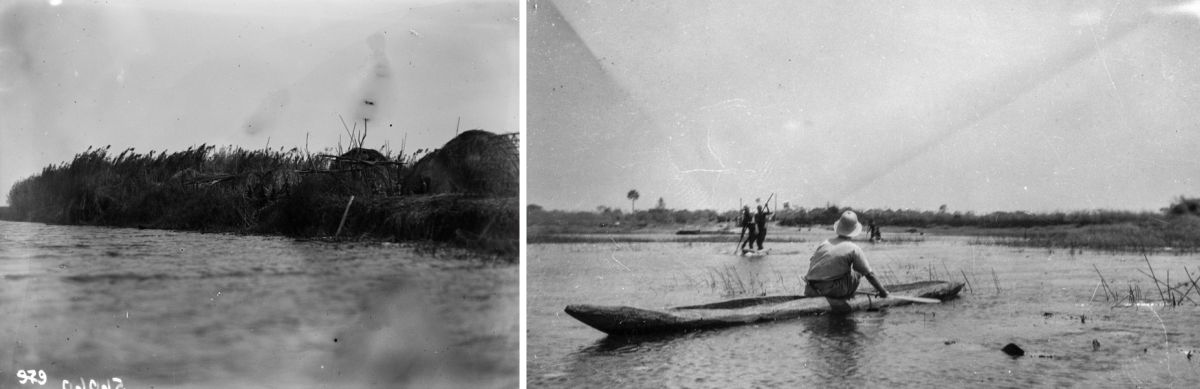
Figure 9. Left: A lakeside settlement on the shore of Lake Bangweolo, with thatched huts and villagers looking towards the camera. Right: An expedition member travelling by canoe on the lake, with local canoeists visible in the background. Courtesy of: © Deutsche Fotothek / Unbekannter Fotograf.
Another lake associated with Schomburgk and the ‘Chimpekwe’ is Lake Dilolo in Angola, towards which the expedition subsequently proceeded. The party first reached the similarly named town of Dilolo in the Belgian Congo (now the Democratic Republic of the Congo) and crossed into Angola at the nearby railway town of Teixeira de Sousa (now Luau). There, Schomburgk encountered the French-speaking Portuguese Fernando Guimarães, whom he engaged as an interpreter for the onward journey to the coast. In the course of a conversation about the two lakes, Dilolo and Bangweolo, the term ‘Chimpekwe’ arose, prompting Guimarães to remark that he was likewise familiar with this unusual animal from Lake Dilolo, which he considered unknown to science, and that he had once possessed a piece of its fur. Heuvelmans’ rendering of Schomburgk’s German ‘Fell’ as ‘skin’ was imprecise, though it may reflect the less developed state of his interpretation in 1955. In light of his later treatment of some related Chipekwé reports as possible partly aquatic sabre-toothed cats, the neutralisation is more striking, since ‘Fell’ would have better suited the later mammalian reading. Although Guimarães had already given it away and promised to recover it for Schomburgk, this did not materialise.
The expedition itself never reached Lake Dilolo and therefore carried out no independent investigations there. The association of the lake with the ‘Chimpekwe’ phenomenon consequently rests primarily on Guimarães’ statement. Although Heuvelmans (1978) assigns a ‘major role’ to Lake Dilolo, it functions in his account only as a connective node linking disparate reports, a connection reinforced by reference to interconnected river systems. Rather than examining contiguous local traditions associated specifically with Dilolo, he surveys heterogeneous accounts from the wider region without demonstrating vernacular or descriptive continuity with the Chimpekwe reports from Lake Bangweolo. This limitation is strengthened by Heuvelmans’ own admission that no description of the Lake Dilolo ‘Chipekwé’ was available. Any continuity between these reports is therefore chiefly interpretative, rather than based on demonstrable local or descriptive continuity.
The ‘Great African Expedition’ concluded in 1932, and upon his return Schomburgk gave interviews concerning an ‘African secret’:
Hans Schomburgk has returned from his eighth African expedition. Before continuing on to Berlin, he plans to spend a short time in his hometown of Hamburg. A representative of the Conti News Bureau had the opportunity to interview Schomburgk about the course and results of his expedition. The African explorer reported: The journey went from Durban to Lobito, a route never before undertaken. The main scientific purpose of the venture was to confirm Schomburgks claim that the disputed Lake Bangweolo was not a swamp, but a lake like the other lakes of the Central African Rift. This evidence should be considered conclusive. Approximately 16,000 meters were filmed, which will likely be shown in four films [one film was released in October 1932 titled ,The last paradise’]. When asked about his future plans, Schomburgk stated that he considered Africa „exploited“ for the film. One could no longer bring surprises about Africa, so a new film assignment would no longer entice him to travel there. What he brought back this time was valid for vast areas and surpassed everything achieved so far in every respect. Only one thing, said Schomburgk, would entice him to undertake a new journey: a commission to search for that legendary animal about which he had long been collecting information and about whose existence, at least in a limited, lost region, there could hardly be any doubt—that mysterious dinosaur offspring that was said to eat hippos. Schomburgk described the trip as the most dangerous he had ever undertaken, even though it passed without any major accidents. The stated goals were achieved. According to the researchers, the films taken will provide unprecedented insights into Africa’s wildlife.’ (,Riesensaurier am Kongo’ 1932; ,Hans Schomburgk berichtet über seine 8. Afrikaexpedition’, 1932).
By early 1932, Schomburgk had helped bring the ‘Chimpekwe’ into the German public sphere as a mysterious, possibly prehistoric animal associated with Bangweolo and, more loosely, Dilolo. Yet the material remained unstable and poorly defined, making it readily available for journalistic adaptation, conflation, and eventual transformation in the Johanson report.
The original Johanson report
The current state of research concerning the original newspaper report attributed to J. C. Johanson was outlined by Bernard Heuvelmans (1978), as noted above. He observed that the ‘Cologne Gazette’, as referenced in the South African newspapers, appeared to refer to the Kölnische Zeitung. This interpretation is plausible not only as a literal translation, but also because the Kölnische Zeitung was a well-known newspaper with a national reputation, published in Cologne by M. DuMont Schauberg. After examining issues from the first half of 1932, however, Heuvelmans concluded that it was unlikely that Johanson’s photograph (or the accompanying article) had appeared in this particular newspaper, noting that it rarely published images and, when it did, these were typically limited to portraits of prominent individuals.
The investigation presented here demonstrates that the Johanson report was indeed not published in the Kölnische Zeitung, but in a second Cologne-based periodical issued by the same publishing house, the Kölnische Illustrierte Zeitung (Cologne Illustrated Newspaper). This illustrated weekly appeared in Cologne from 1926 to January 1945 (ZDB, n.d.; zeit.punkt NRW, n.d.). Its large-format illustrated layout and mixture of reportage, cultural material, and popular-interest articles are consistent with comparison of digitised issues. The present analysis is based on a digitised scan of the relevant issue; minor portions of the text have been reconstructed where the scan is illegible.
— — —
The story of a “Giant dinosaur on the Congo” (1932), described as “the largest zoological find in 200 years,” was prominently presented across a double-page spread, accompanied by five photographs of varying sizes. The article, printed in German blackletter (Fraktur), is reproduced in the following quotation:
‘The „Kassaisaurus,“ the last prehistoric creature
The long-suspected, long-sought giant dinosaur found in the Kassai area / The great accidental discovery of the Swedish plantation assistant Jan C. Johanson 100 kilometers east of Mai Muene
Just a few days ago, we received an inconspicuous picture package bearing the postmark: „Mai Muene, Territoire du Kassai, Congo belge“. It contained two small 9×12 photos and several rolls of film of the same size. The images were blurry and shaky, but it was clear at first glance that they contained a message of incalculable importance: the discovery in the forests of the Congo of a giant dinosaur species still alive today, whose ancestors became extinct many thousands of years ago. The owner of these pictures, Jan C. Johanson, a Swedish plantation assistant for a Belgian rubber company, wrote the following stirring report, which, in its simplicity, we will allow to speak for itself.
Sir, I am enclosing some photographs I took a few days ago, which contain a discovery that I believe is very important. Please be so kind as to reproduce them and send them to the Zoological Institute in Berlin for scientific examination.
On the morning of February 16, I marched with five boys from my station No. 18 to station No. 22 to inspect the camps operations. The inspection was completed at 11 a.m., and I ordered my rifle boy to accompany me on the hunt. He carried my Winchester rifle for small game; I don’t have a license for big game and didn’t think I’d find any. At 2 a.m., I reached the steep slope of the Kassai Valley; there was no game in sight. Halfway down the descent, my boy suddenly called out, „Elephants, sir!“ From a small rise, I looked down into one of the side valleys and spotted two huge bull elephants with enormous tusks, half-hidden by undergrowth and clumps of trees. They were the largest and strongest elephants I had ever seen. And then I saw something else, something incredible, something I’d never seen before: Down below, perhaps fifty meters away from the motionless pachyderms, stood a monster, about 15 meters long, with a lizard’s head and tail. I closed my eyes and opened them again: It was still there, reality, not an illusion. The boy lay next to me, his face in the grass, moaning softly: So he’d discovered „it“ too! The hunting fever, a terrible fear, shook me; my teeth chattered. Down there stood a piece of prehistory, and I was allowed to see it! With flying hands, I pulled out my camera; I pressed the shutter three times; but only one photo was successful. After the third shot, the monster disappeared into the jungle with surprisingly quick, uncanny movements.
It took a while for me to gather myself; the boy next to me was trembling and howling. I pulled him up from the ground and pushed him ahead of me, and we began the march back to the station. After twenty minutes, we had to cross a large swamp, through which we made only slow progress. We walked very quietly and carefully, the shock from earlier still in our limbs. Suddenly, I stopped rooted to the spot behind a wall of reeds: in the swampy river arm in front of me, the monster reappeared. It was feeding on a dead rhinoceros and was covered all over with mud. The distance was perhaps twenty meters: it was horrible. The boy had disappeared with the rifle; I had no weapon. At first, I didn’t dare move; then I remembered my camera.
The monster devoured the rhino carcass; the cracking of bones between its jaws sounded across. As the shutter clicked, the monster disappeared into the forest with a tremendous leap. It was too much for my frayed nerves: I collapsed, completely exhausted, next to the reed bush behind which I had been standing. I felt faint. The sight of this beast, lifting its immense mass out of the water in a leap and disappearing into the black swamp with a lightning-fast turnaround, was the most horrific thing I have ever seen. I must have looked like a madman when I arrived at Camp 22 after many hours; my friend Metcalfe, who heads the 22nd District and received me at the camp, claims I came toward him waving my camera and uttering incomprehensible screams. It must have been so; I lay for eight days in feverish chills, almost unconscious, in Mai Muene, from where I am writing you this letter today.
Yours sincerely,
Signed Jan C. Johanson, Plantation Assistant‘
A comparison of the passage explicitly presented as an extract in the Cape Argus with the original text shows that the later version is indeed a shortened and partially adapted rendering rather than a verbatim reproduction. Stylistic smoothing and rephrasing occur throughout. It retains the overall sequence of events as well as key elements—such as the initial sighting and the second encounter at the swamp—while omitting numerous contextual details and modifying certain formulations.
Aside from these textual characteristics, the Johanson account itself has received comparatively little analytical attention, as discussions have focused primarily on the creature depicted in the photograph and its association with the Grobler case. As previously noted, Heuvelmans (1978) criticised the text’s overtly entertaining style, while Shuker (2016) pointed to the absence of a local name for such a conspicuous creature—observations that apply equally to the original account. In addition, the circumstances of its transmission raise further questions: it remains unclear why a Swedish individual employed by a Belgian company in Africa would have chosen to contact a German newspaper, requesting that the material be forwarded to the Zoological Institute in Berlin, rather than addressing a newspaper or scientific institution in Africa, Belgium, or Sweden.
Against this background, it may also be noted that, under different circumstances, certain elements of the account might have been subject to verification—some already at the time, others only in light of the original text now available—such as the Belgian rubber company and the potential presence of rhinoceroses in the specified region. However, other aspects would inevitably have remained doubtful, particularly the reported observation of a fifteen-metre-long creature with a lizard-like head and tail. Given the absence of any recent reptiles of such size and the account’s use of the term ‘prehistoric’, such claims would almost certainly have been interpreted within the framework of the prehistoric survivor paradigm, as already reflected in earlier discussions (e. g. Sanderson, 1948).
— — —
Before turning to the two larger and more significant photographs, the three smaller images will be considered first.
The smallest image, located at the top right of the first page, shows a portrait of Johanson (Figure 10). The accompanying caption reads: ‘The Swede Jan Johanson, who saw what were probably the last dinosaurs in front of the camera as he descended from Mount Kambuankale’. Given the nature of a reported eyewitness account transmitted in letter form, the inclusion of a portrait photograph appears somewhat unusual, since such images were more likely the result of editorial selection than an integral component of the original report. A preliminary online search has yielded no further information about the depicted individual; Mount Kambuankale, however, is recorded on historical maps (Scobel, 1921).
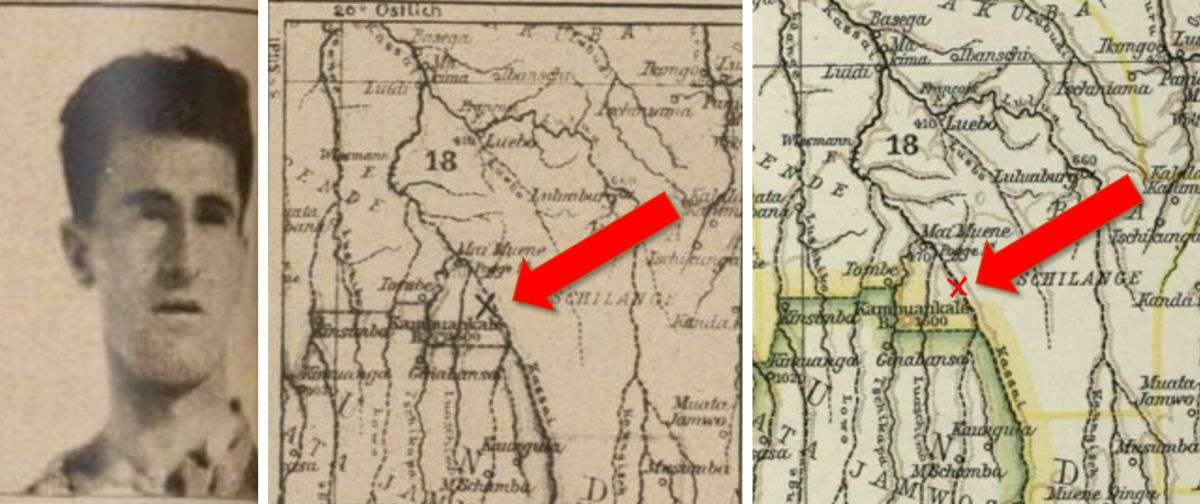
Figure 10. Left: Portrait of Jan C. Johanson. Centre: Map detail reproduced with the original report, marking the alleged location of the incident. Right: Comparative map detail from Scobel’s Andrees Allgemeiner Handatlas (1921), showing the same area around Mount Kambuankale and the Kasai. Sources: left and centre: “Riesensaurier am Kongo,” Kölnische Illustrierte Zeitung, (1932); right: Scobel (1921b), public domain.
A second small image reproduced on the page consists of a clipping from a German map (note the term ‘östlich’, meaning ‘eastern’), indicating the location where Johanson allegedly encountered the creature (Figure 10). The map of the Kassai district marks, with a cross, the point at which the approximately 1,500-metre-high Kambuankale intersects with the Kassai. The map itself corresponds to Scobel (1921), although it likely derives from one of several editions of the same atlas, which cannot be identified with certainty.
The third small image, located at the bottom right of the second page, is a clipping from a newspaper article titled ‘Afrikanisches Geheimnis’ (‘African Secret’), concerning the conclusion of Schomburgk’s 1931/1932 expedition. Although the exact source remains unverified, the text corresponds to versions previously cited in this article (‘Riesensaurier am Kongo’, 1932; ‘Hans Schomburgk berichtet über seine 8. Afrikaexpedition’, 1932).
— — —
The first large photograph, positioned on the left side of the double page, depicts the second scene described in the report, in which both men, having fled through the swamps, encounter the creature again (Figure 11). It is shown standing over a seemingly dead rhinoceros in a swamp hollow, surrounded by bushes or sloping vegetation. The ground at the edge of the hollow appears visibly wet, suggesting that an animal had recently entered or emerged from the water. The caption beneath the photograph reads: ‘The African explorer Schomburgk, who suspected a large dinosaur in the Congo region, was right. The Kassaisaurus defeats a rhinoceros in the hollow.’
The image corresponds to the version that appears, in reduced quality and cropped form, in South African newspapers (‘Met the mystery monster’, 1932; ‘Monster Lizard of Central African Swamps’, 1932), and was subsequently reproduced in later works dealing with the Johanson report, such as Heuvelmans (1955, 1978) and Cohen (1970).
A comparison between the original image and its later newspaper reproduction reveals a clear amplification of compositional artefacts. While the underlying photographic elements already exhibit inconsistencies in scale, lighting, and spatial integration, these become significantly more pronounced in print. In particular, halftone reproduction increases contrast and reduces tonal gradation, producing visible light margins along the outline of the reptile. These halo-like effects create a distinct visual separation between the inserted figure and its background, thereby rendering the composite nature of the image more apparent in the printed version than in the original montage. By contrast, illustrated periodicals such as the Kölnische Illustrierte Zeitung or the Illustrated London News typically employed higher-quality materials and finer halftone screens than standard daily newspapers, which helped preserve tonal transitions and made retouching seams or montage artefacts less conspicuous.
Taken together, these observations suggest that, given its publication date in 1932, the image is best interpreted as an example of analogue photomontage. The observed inconsistencies are characteristic of composite images produced by physically combining separate photographic elements, followed by retouching and subsequent rephotographing—techniques that were well established in early photographic practice (Gernsheim, 1955).
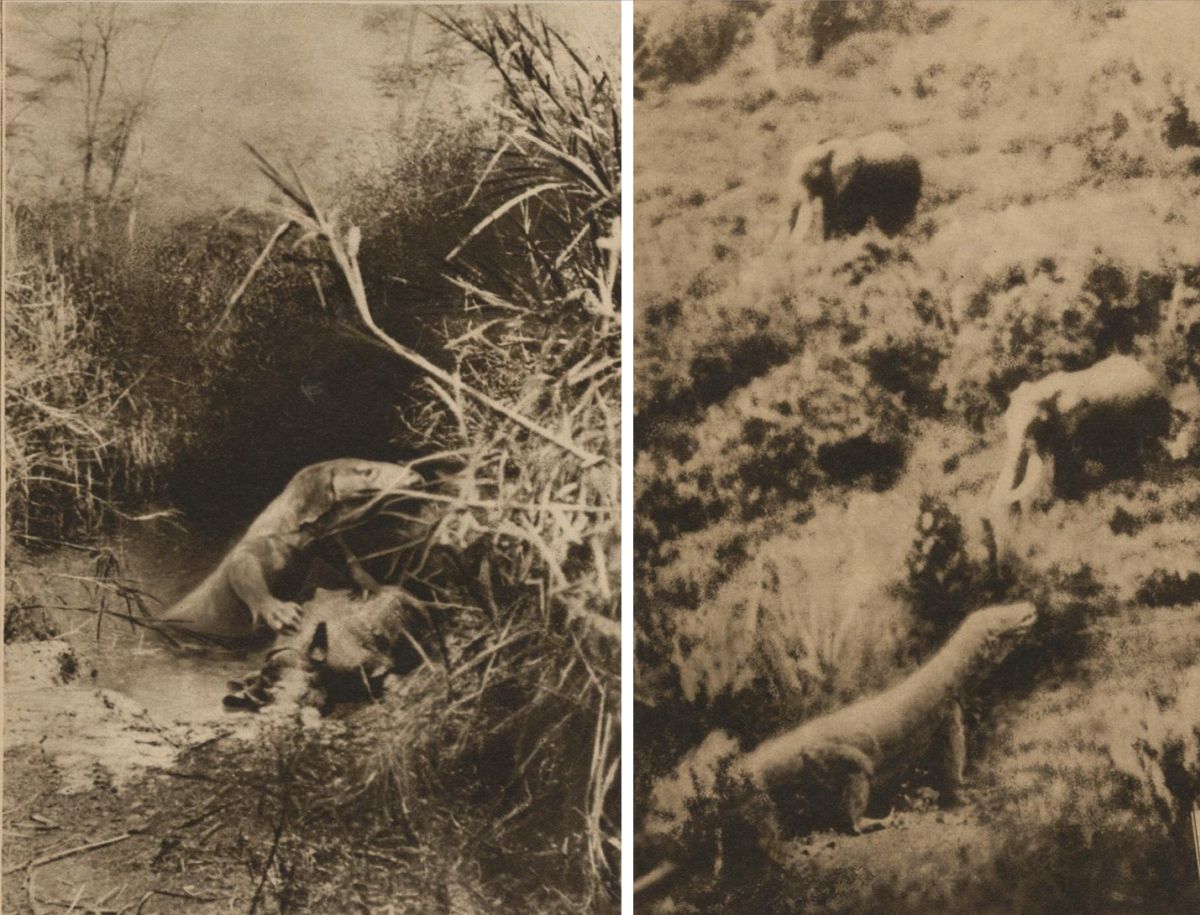
Figure 11. The two photomontages published with the Johanson report. Left: The alleged ‘Kassaisaurus’ over a rhinoceros in a water-filled hollow. Right: A second composite image placing the inserted monitor-lizard figure in an elephant scene. Source: “Riesensaurier am Kongo,” Kölnische Illustrierte Zeitung (1932).
— — —
The second large photograph depicts the first scene described in the report, showing two elephants moving through a bush-covered landscape rather than the dense jungle described in the text, while maintaining a slight lateral distance from one another (Figure 11). The scene appears to be captured from an elevated vantage point, looking down onto the terrain. In the foreground, a large reptilian figure is clearly visible: apart from portions of the tail, which are partially obscured by vegetation, the body of the animal remains fully exposed. It is positioned more or less directly in front of the nearer elephant, although its orientation suggests that it is not actively confronting it but rather turned slightly away. The lack of direct interaction between the animals further contributes to the impression that the elements were composed rather than captured in a single moment. The elephants appear more consistent with savannah elephants (Loxodonta africana) than with forest elephants (Loxodonta cyclotis), which would be the more expected form in a dense Congolese forest setting. This impression rests primarily on the tusks, which seem relatively long and outward-curving rather than short, straight, and downward-pointing. Secondary indicators, such as the apparent body size, the open, bush-covered landscape, and the slightly concave dorsal profile, may also point in this direction, although these features are more difficult to assess reliably from the image and the identification remains tentative.
Compared to the first photograph, the image appears somewhat softer and less defined, yet it exhibits similar technical characteristics, indicating a comparable mode of production and reproduction. Taken together, these observations support the interpretation of the image as a composite rather than a single, continuous photographic exposure.
— — —
As previously noted, Schomburgk functioned as a prominent reference point within the article. His recent expedition and his documented engagement with reports of unknown animals in Central Africa formed part of the immediate contemporary context in which the article was produced.
The question of the article’s intention can be resolved by its date of publication: as it was issued on 1 April, it constitutes an April Fools’ hoax. This is further confirmed by a follow-up article published several days later, in which the story was explicitly resolved, in keeping with a broader journalistic tradition of disclosing such fabrications:
‘Aprils fool!
Well-known researchers have long suspected that there was still a living species of dinosaur in inner Africa, and only recently Schomburgk confirmed this assumption. This gave the editorial team of the Cologne illustrated newspaper the reason to „invent“ this dinosaur descendant on April 1st. Photographs of monitor lizards, the large lizards that live on the Sunda island of Komodo, were mounted in appropriate proportions in African jungle images; Mr. Johansen’s letter was quickly invented – and the greatest zoological discovery of the last two hundred years had occurred.‘
In the middle of the page, a sketched monitor lizard is shown sitting upright and holding the two original background photographs used for the joke; unfortunately, the artist’s handwritten signature cannot be deciphered. An accompanying text clarifies:
‘The Kassaisaurus – is still not discovered; A giant monitor lizard from Komodo was copied into two hunting pictures by the African explorer Schillings; the newspaper clipping is real! (the pictures come from Schilling’s book „Mit Blitzlicht und Büchse“ [With flashlight and rifle], R. Voigtländers Verlag, Leipzig)’.
The elephant photograph by Carl Georg Schillings (Figure 12) supports the interpretation that the animals are savannah elephants, as it was taken on the western slopes of Kilimanjaro. It shows two animals moving across an open, scrub-covered slope, maintaining a slight distance from one another, with the nearer individual more prominently visible in the foreground. The caption reads: ‘Two huge elephant bulls captured in a jungle valley in western Kilimanjaro amidst house-high vegetation. Each of this animal’s tusks is estimated to weigh around 80 kilos. Distance about 300 metres.’
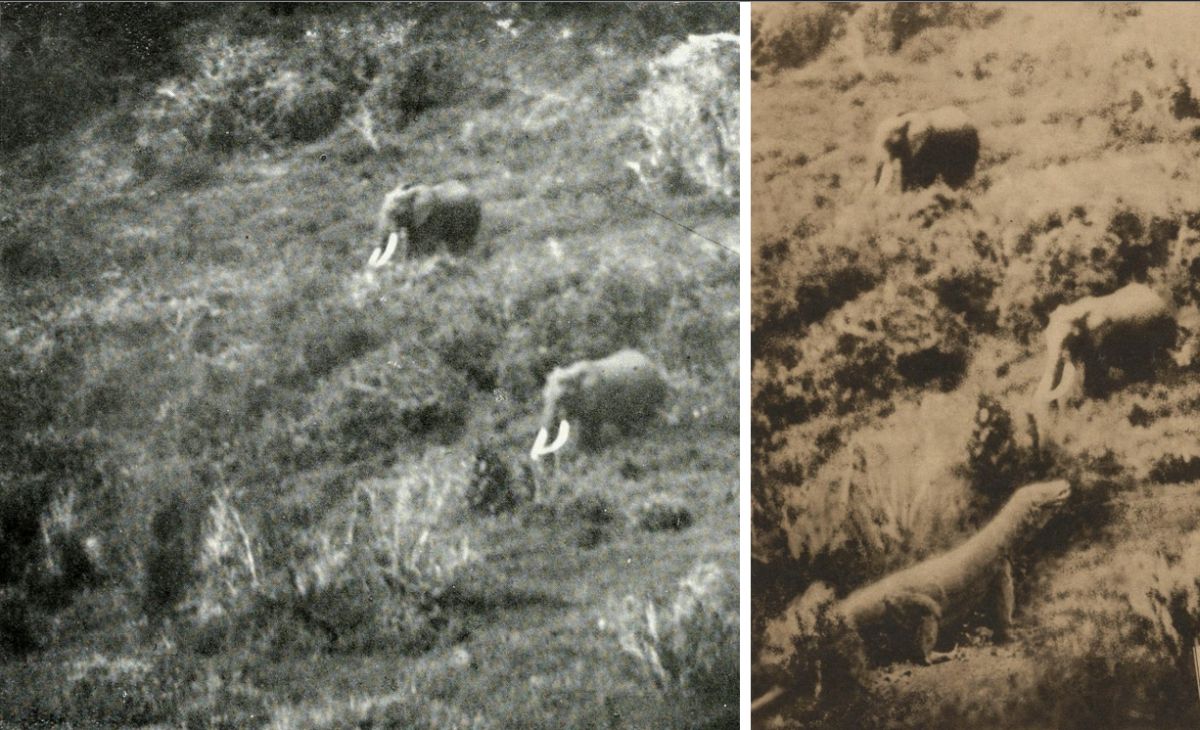
Figure 12. Left: Original photograph by Carl Georg Schillings, showing elephants in a bush landscape. Source: Schillings, Mit Blitzlicht und Büchse (1905; Schillings, 1905a). Right: Photomontage from the Johanson report, combining an inserted reptilian figure with the elephant background. Source: “Riesensaurier am Kongo,” Kölnische Illustrierte Zeitung (1932).
The inserted reptilian figure in the elephant photomontage corresponds to a photograph of a Komodo dragon reproduced in William Douglas Burden’s Dragon Lizards of Komodo (1927). The montage therefore combines Schillings’ East African elephant photograph with a Southeast Asian monitor lizard, confirming the hybrid construction of the image.
By contrast, the source image underlying the previously known Johanson photograph shows two rhinoceroses in a narrow, water-filled hollow bordered by dense vegetation, one standing in the background while the other lies partially submerged in the foreground (Figure 13). The near-frontal orientation of the standing animal facilitated the insertion of an additional figure, since parts of its outline could be more easily concealed by visibly blackened retouched areas.
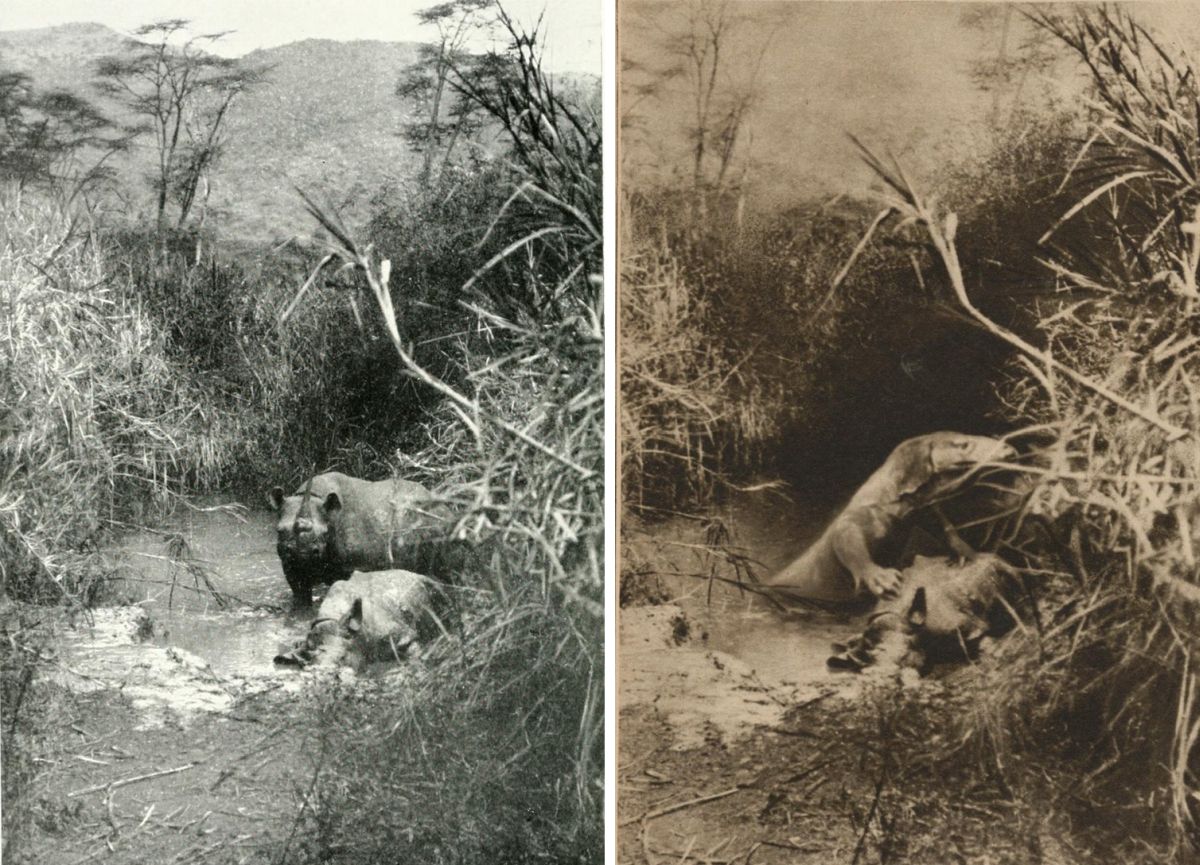
Figure 13. Left: Original photograph by Carl Georg Schillings, showing two rhinoceroses in a bush-covered landscape. Source: Schillings, Mit Blitzlicht und Büchse (1905; Schillings, 1905b). Right: Photomontage from the Johanson report, combining an inserted reptilian figure with the rhinoceros background. Source: “Riesensaurier am Kongo,” Kölnische Illustrierte Zeitung (1932).
A second photograph of the same animals exists, in which the rear rhinoceros turns forward and is thus shown fully in lateral view relative to the scene. Unlike the selected image, this version presents a larger surface area; inserting an additional figure would therefore have required a larger portion of the background to be obscured or blacked out. It was consequently less suitable for this manipulation.
It is also notable that the blackened retouching is considerably more conspicuous in the original Kölnische Illustrierte Zeitung reproduction than in the later Cape Argus/Rhodesia Herald derivatives or in Heuvelmans’ reproduction. The difference results from cropping and subsequent newspaper reproduction: the later versions show only a section of the original image, thereby reducing the visibility of the surrounding manipulated areas.
The Grobler report
It has long seemed plausible that the photograph submitted to the Cape Argus accompanied the report published in the Kölnische Illustrierte Zeitung, but this connection had not previously been demonstrated conclusively. The present analysis confirms this assumption.
At the same time, several questions relating to the Cape Argus article and Grobler’s statements remain unresolved. The identity of the individual who forwarded the Johanson report to the Cape Argus cannot be determined from the available material, and any implications arising from this remain unclear. Likewise, the claim that Grobler had spent five years in Central Africa cannot be verified in detail and, if accurate, was evidently not continuous, as he was recruited for the Schomburgk expedition in Durban, South Africa.
The claim that he first heard of the creature from local informants at Lake Bangweolo is not implausible in itself. However, given his participation in the Schomburgk expedition, it appears more likely that he was already familiar with the term through Schomburgk. His account of eliciting information from local informants is therefore somewhat questionable, particularly as the content he reports does not extend beyond what Schomburgk already knew. Grobler’s additional use of the expression ‘water lion’ is also notable, particularly in view of the motif’s later importance in Heuvelmans’ categorisation of at least some ‘Chimpekwe’ reports. The route by which this designation entered Grobler’s account remains unclear. It cannot presently be determined whether the term reflects information acquired through the expedition milieu, including Schomburgk and Guimarães, independently gathered local testimony, or some other undocumented route of transmission.
Grobler’s account presents a relative sequence of events, but this sequence is chronologically imprecise. He stated that he first heard of the ‘Chepekwé’ at Lake Bangweolo in August of the previous year. The precise dating, however, does not agree with the known expedition chronology: the expedition was not at Lake Bangweolo in August, as implied, but rather in October 1931. These discrepancies affect the exact dating of the reported stages, but not the broader point that Grobler’s acquaintance with the term and tradition, whether placed in August according to his own account or in October according to the actual itinerary, falls within the period of the Schomburgk expedition. The additional enquiries he later describes in Angola would therefore have to be placed after that point. This creates a further difficulty, since Schomburgk (1936) stated that Grobler was to return to South Africa on the next steamer after the expedition. If so, Grobler’s alleged subsequent return to the Congo and Angola, his illness, and his arrival in Cape Town before the July 1932 Cape Argus reports would have required a very compressed sequence of events.
A chronological difficulty also bears on Grobler’s statement that the ‘Chepekwé’ had been discovered by an unnamed ‘German scientist’ at Lake Dilolo ‘about six months’ earlier. Measured against the publication date of the Cape Argus report, this would point to January 1932, near the end of the Schomburgk expedition, but no such ‘discovery’ is otherwise known. It is therefore more likely that the statement refers loosely to the expedition’s correctly dated presence at Lake Dilolo in October–November 1931. Heuvelmans (1978) already wondered whether the ‘German scientist’ might have been Schomburgk and asked why he was not explicitly identified. Yet this question may assume too narrow a range of candidates, since several scientifically trained participants were involved in the expedition. The expression ‘German scientist’ need not therefore designate Schomburgk specifically; if it did, it may reflect Grobler’s loose terminology rather than a precise description of Schomburgk’s role. Grobler may have used ‘discovered’ with similar looseness, perhaps referring simply to the information about a Lake Dilolo ‘Chimpekwe’ that Guimarães had communicated to Schomburgk.
Grobler’s sentence links this alleged Dilolo discovery with the further claim that he had seen photographs of the animal while in Angola. If these photographs are to be identified with the Johanson material, he cannot have seen them at least before 1 April 1932, when the Johanson photographs first entered public circulation. The statement in this case is therefore chronologically possible only if the Angola visit in question occurred after that date. The difficulties are further compounded by the fact that Grobler explicitly refers to multiple images, yet provides a description of only a single scene, leaving the content and context of the remaining photographs unspecified. This problem had already been recognised by Heuvelmans (1978), who regretted that Grobler had never clarified the circumstances under which he had seen the photographs and later noted that he himself had seen only one such image: the photograph published in the Cape Argus and reproduced in the Rhodesia Herald. The material may therefore refer either to the Johanson photographic material or to otherwise unknown sources, although the latter possibility remains unsupported. No contemporary correction by Grobler has been traced that would challenge the identification of the photograph published by the Cape Argus with the material he had mentioned. While this silence cannot be taken as proof—given the contingencies of newspaper editorial practice—it is at least consistent with the possibility that his reference ultimately derived from the Johanson material rather than from a separate, now-unidentified photographic source. What can be stated more securely is that Grobler’s account tends to subsume geographically distinct reports from Angola and the Congo under the single label ‘Chimpekwe’, thereby producing a broader pattern of conflation.
In this context, Grobler’s description of a ‘Chepekwe’ standing over a dead hippopotamus is particularly notable, as it corresponds closely to the later hoax imagery, making a purely coincidental resemblance difficult to maintain. The discrepancy in the identification of the prey animal (rhinoceros versus hippopotamus) remains unresolved and may reflect either the poor quality of the image or the prominence of hippopotamuses in Bangweolo-related ‘Chimpekwe’ traditions. By contrast, neither rhinoceroses nor elephants appear to form part of this core tradition, nor are they independently corroborated in the available source material in this context. Their presence in Grobler’s account is therefore more plausibly interpreted as narrative or visual borrowing from the Johanson material than as evidence of a consistent tradition. His additional reference to a witness from the Kasai region further links Grobler’s account geographically to the setting of the Johanson report. This convergence suggests possible familiarity with the Johanson material, although it cannot be demonstrated conclusively.
Summary and Conclusion
This article reconstructs the transmission and reception of the Johanson report through a systematic examination of primary and secondary sources. In doing so, it identifies the original German-language newspaper publication underlying the account and brings to light the associated photographic material.
The analysis of a newly identified follow-up article demonstrates that the Johanson report, as published in 1932, constitutes an April Fools’ hoax. The underlying account can be situated within a broader contemporary context shaped in part by Hans Hermann Schomburgk’s reports of the ‘Chimpekwe’, which provided part of the background and inspiration for the construction of the hoax.
The Grobler material further indicates that his statements contain chronological inconsistencies, geographical and terminological conflations, and an ambiguous reference to photographic evidence. His account appears to have recombined elements from Schomburgk’s reports, local traditions, unclear lines of transmission, and possibly the Johanson material itself. In particular, the reference to a creature standing over a dead hippopotamus, together with the inclusion of rhinoceroses and elephants as prey animals, suggests a narrative shaped by circulating reports and images rather than by a stable, independently documented tradition. His additional reference to a witness from the Kasai region further links his account geographically to the setting of the Johanson report.
The findings further suggest that the case may already have been noted before Bernard Heuvelmans by Ingo Krumbiegel, whose brief remarks indicate an awareness of the fabricated nature of the photographic material. While it cannot be established with certainty that he referred to the same report identified here, the close correspondence in content makes such a connection plausible.
Later interpretations, particularly in popular culture, introduced substantial distortions, culminating in the emergence of the so-called ‘Kasai Rex’. Although the original Johanson account described the creature only as a large lizard-like animal, its size, predatory behaviour, association with rhinoceroses and elephants, and its early presentation in the press as a possible prehistoric survivor left open an interpretative path towards a theropod—and eventually specifically Tyrannosaurus-like—reading. Mid-twentieth-century examples such as Le Journal de Tintin and the later illustrations by Gino D’Achille show that this possibility was already latent in the reception of the report before it developed into the more elaborate ‘Kasai Rex’ tradition.
Finally, the reconstruction of the original Johanson source makes it possible to identify ‘Kassaisaurus’ as the earliest documented designation of the creature. It is therefore proposed that this term be used in future discussions to distinguish the historically attested account from its later, largely fictionalised reinterpretations.
Acknowledgements
I am grateful to Karl P. N. Shuker, whose enquiry regarding the spotted bushbuck stimulated my interest in African cryptids connected with German travellers. I also thank Tyler Greenfield for drawing my attention to William Douglas Burden’s Dragon Lizards of Komodo, and the Naturéum (formerly the Musée cantonal de zoologie de Lausanne), Fonds Bernard Heuvelmans, for providing access to archival materials relating to the Cape Argus and the Rhodesia Herald.
I further wish to acknowledge Hans-Jörg Vogel from Forschungsarchiv Afrikanische Kryptide for his assistance and valuable comments. I am also indebted to Studio D’Achille for granting permission to reproduce artwork by Gino D’Achille, and to the Deutsche Fotothek for granting permission to use photographs of the 1931/1932 Schomburgk expedition.
Bibliography
A 4-ton lizard. (1932, August 2). The Liverpool Echo.
À la recherche du monde perdu. (1955). Le Journal de Tintin, (42).
Akimuschkin, I. (1963). Es gibt doch Fabeltiere! (H.-J. Thier, Trans.). F. A. Brockhaus.
Alan Friswell: Rhino rex revealed!! Revealing and revelatory reportage!! (2010, March 30). CFZ Blog. https://forteanzoology.blogspot.com/2010/03/alan-friswell-rhino-rex-revealed.html
Amman, Z. (2025, July 2). Jurassic World Meets the Unknown: Dinosaurs & Mystery Beasts of the Congo Basin. AllThatHistory. https://allthathistory.com/unexplained-phenomena/jurassic-world-dinosaurs-mystery-beasts/2920/
Among the magazines. (1937, August 8). The Washington Post.
April! April! (1932, April 9). Kölnische Illustrierte Zeitung. Retrieved 13 July 2025, from https://zeitpunkt.nrw/ulbbn/periodical/zoom/26530884
Are the CFZ relaxing their stance. (2010, March 31). https://cryptozoologythetruth.blogspot.com/2010/03/are-cfz-relaxing-their-stance.html
Ausstellung ‘Carl Georg Schillings’—Startseite. (n.d.). Retrieved 23 April 2026, from https://stadtmuseumdueren.de/stadtgeschichte/ausstellung-schillings.html
Baldus, R. D. (Ed.). (2014). Auf Safari: Legendäre Afrikajäger von Alvensleben bis Zwilling. Kosmos.
Bangweulu Wetlands Zambia. (2015, March 21). Hippo in Bangweulu Swamps. https://www.facebook.com/photo.php?fbid=423869471113411&set=pb.100068819582502.-2207520000&type=3
Biografie Hans Herrmann Schomburgk 1890—1967. (n.d.). Retrieved 19 October 2025, from http://www.alt-querfurt.de/index.php?seite=schomburgk1c
Bright, M. (1987). The living world. Hamlyn.
Burden, W. D. (1927). Dragon lizards of Komodo: An expedition to the lost world of the Dutch East Indies. G. P. Putnam’s Sons.
Campbell, D. (1922). In the Heart of Bantuland: A Record of Twenty-Nine Years’ Pioneering in Central Africa Among the Bantu Peoples, With a Description of Their Habits, Customs, Secret Societies and Languages. Seeley, Service & Co.
Central African ‘monster’. (1932, July 8). Cape Argus.
Chepekwe does exist. (1932, July 9). Cape Argus.
Chipekwe. (2025a, September 25). Encyclopaedia of Cryptozoology. https://cryptidarchives.fandom.com/wiki/Chipekwe
Chipekwe. (2025b, September 26). Cryptid Wiki. https://cryptidz.fandom.com/wiki/Chipekwe
Chomba, C., Senzota, R., Chabwela, H., & Nyirenda, V. (2013). Does shore length influence population size and density distribution of hippopotamus? Journal of Ecology and the Natural Environment, 5(4), 56–63.
Clark, J. (1993). Encyclopedia of strange and unexplained physical phenomena. Gale Research.
Clarke, A. C. (1981). Arthur C. Clarke’s Mysterious World. Collins.
Cohen, D. (1970). A modern look at monsters: Illustrated. Dodd, Mead & Co.
D’Achille, G. (1978). Illustration of the Johanson account, depicting a theropod-like creature feeding on a rhinoceros in a swamp setting [Graphic]. In D. Farson & A. Hall, Geheimnisvolle Wesen und Ungeheuer. Aldus Books.
Do mystery animals exist? (1938, January 26). The Goulburn Evening Penny Post.
Eberhart, G. M. (2002). Mysterious creatures: A guide to cryptozoology. ABC-CLIO.
Facts about the Chepekwe. (1932, August 1). The Evening Standard.
Farmer, A. (1933, February 24). Mystery beasts that haunt jungle. The Sunday Sun.
Farson, D., & Hall, A. (1978). Geheimnisvolle Wesen und Ungeheuer. Aldus Books.
Farson, D., & Hall, A. (1979). Grosse Mysterien. Moderner Buchvertrieb und Verlag GmbH.
Gernsheim, H. (1955). The History of Photography. Oxford University Press.
Giant Lizard. (1932, March 21). The Daily Examiner.
Giant lizard weighs four tons. (1932, October 10). Brisbane Telegraph.
Giant lizard weighs four tons. (1933, March 21). The Daily Examiner.
Gibt es noch Dinosaurier? (1933a, February 2). Münstereifeler Zeitung.
Gibt es noch Dinosaurier? (1933b, February 2). Der Gemeinnützige.
Gibt es noch Dinosaurier? (1933c, February 3). Steinfurter Kreisblatt.
Gibt es noch Dinosaurier? (1933d, February 4). Haaner Zeitung.
Gibt es noch Dinosaurier? (1933e, February 4). Burgische Landes-Zeitung.
Gibt es noch Dinosaurier? (1933f, February 7). Hennefer Volks-Zeitung.
Gibt es noch Dinosaurier? (1933g, February 25). Echo Des Siebengebirges.
Graetz, P. (1912). Im Motorboot quer durch Afrika: Vom Indischen Ozean zum Kongo. Braunbeck & Gutenberg.
Green, L. (n.d.). Fabeltierreich Afrika.
Hagenbeck, C. (1908). Von Tieren und Menschen. Vita Deutsches Verlagshaus.
Hagenbeck, C. (1909). Von Tieren und Menschen. Vita Deutsches Verlagshaus.
Hagenbeck, C. (1912). Beasts and Men. Longmans, Green, and Co.
Hall, A. (1975). Monsters and Mythic Beasts. Aldus Books.
Hans Schomburgk berichtet über seine 8. Afrikaexpedition. (1932, February 24). Rhein- und Ruhrzeitung.
Hausdorf, H. (2003). Die Rückkehr der Drachen. Herbig.
Henson, T. (2014, April 7). Cryptodraco: Mokèlé-Mbèmbé, A Living Dinosaur? Part 3: Kasai Rex & Afroraptor. Cryptodraco. https://cryptodraco.blogspot.com/2014/04/mokele-mbembe-living-dinosaur-part-3.html
Heuvelmans, B. (1955). Sur la piste des bêtes ignorées. Plon.
Heuvelmans, B. (1958). On the Track of Unknown Animals. Rupert Hart-Davis.
Heuvelmans, B. (1959). On the Track of Unknown Animals. Hill and Wang.
Heuvelmans, B. (1972). On the Track of Unknown Animals. MIT Press.
Heuvelmans, B. (1978). Les derniers dragons d’Afrique. Plon.
Heuvelmans, B. (1986). Annotated checklist of apparently unknown animals with which cryptozoology is concerned. Cryptozoology, 5
Heuvelmans, B. (1995a). On the Track of Unknown Animals. CRC Press LLC.
Heuvelmans, B. (1995b). Photograph attributed to Johanson, showing the alleged monster positioned atop a prey animal [Graphic]. In On the track of unknown animals. CRC Press. After the Rhodesia Herald.
Heuvelmans, B. (2007). Les félins encore inconnus d’Afrique. Les Éditions de l’Œil du Sphinx.
Hill, S. A. (2024, December 20). Pop Goes the Cryptid: Explained. Sharon A. Hill. https://sharonahill.com/pop-goes-the-cryptid-explained/
Huchzermayer, K. (2012). Fishes and Fisheries of the Bangweulu Wetlands and Lavushi Manda National Park [Report]. African Parks Zambia.
Hughes, A. L. (1921). Eighteen Years (1902–1919) on Lake Bangweulu. Government Printer.
Jura. (2009). Turns out Komodo dragons aren’t all that unique afterall [Graphic]. https://reptilis.net/tag/varanus-priscus/
Kasai rex. (2025a, September 25). Encyclopaedia of Cryptozoology. https://cryptidarchives.fandom.com/wiki/Kasai_rex
Kasai Rex. (2025b, September 26). Cryptid Wiki. https://cryptidz.fandom.com/wiki/Kasai_Rex
Kasai Rex. (2026, April 24). Cryptid Wiki. https://cryptidz.fandom.com/wiki/Kasai_Rex
Kasai Rex. (n.d.-a). TrueAuthority. Retrieved 4 April 2026, from https://www.trueauthority.com/cryptozoology/kasai.htm
Kasai Rex. (n.d.-b). Myth and Folklore Wiki. Retrieved 27 September 2025, from https://mythus.fandom.com/wiki/Kasai_Rex
Kasai Rex: A modern day dinosaur hiding in the Congo? (n.d.-c). Paranormal Catalog. Retrieved 4 April 2026, from https://www.paranormalcatalog.net/cryptids/kasai-rex-a-modern-day-dinosaur-hiding-in-the-congo
Kasai Rex, Burrunjor, and mini-T. rex: Evidence of surviving carnivorous dinosaurs? Part 1. (2012, May 30). The Cryptozoologists. https://thecryptozoologists.webs.com/apps/blog/show/15603233-kasai-rex-burrunjor-and-mini-t-rex-evidence-of-surviving-carnivorous-dinosaurs-part-1
Kölnische Illustrierte Zeitung. (1932a, April 1). Composite image placing an inserted monitor-lizard figure in an elephant scene [Photomontage]. In “Riesensaurier am Kongo.” Kölnische Illustrierte Zeitung.
Kölnische Illustrierte Zeitung. (1932b, April 1). Map detail marking the alleged location of the Johanson incident near Mount Kambuankale and the Kassai [Graphic]. In “Riesensaurier am Kongo.” Kölnische Illustrierte Zeitung.
Kölnische Illustrierte Zeitung. (1932c, April 1). Portrait of Jan C. Johanson [Graphic]. In “Riesensaurier am Kongo.” Kölnische Illustrierte Zeitung.
Kölnische Illustrierte Zeitung. (1932d, April 1). The alleged Kassaisaurus over a rhinoceros in a water-filled hollow [Photomontage]. In “Riesensaurier am Kongo.” Kölnische Illustrierte Zeitung.
Krumbiegel, I. (1950). Von neuen und unentdeckten Tierarten. Franckh’sche Verlagshandlung.
Kuenheim, H. von. (2009). Carl Hagenbeck. Ellert & Richter.
Ley, W. (1948). The Lungfish, the Dodo, and the Unicorn: An Excursion into Romantic Zoology. Viking Press.
López Luna, G. (2023). La leyenda del Kasai Rex. Amazon Digital Services LLC – KDP.
Loxton, D., & Prothero, D. R. (2013). Abominable science! Origins of the Yeti, Nessie, and other famous cryptids. Columbia University Press.
Mackal, R. P. (1987). A living dinosaur? In search of Mokele-Mbembe. Brill.
Man, J. (1978). The natural history of the dinosaur. Gallery Books.
Melland, F. H. (1911). Bangweulu Swamps and the Wa-Unga. The Geographical Journal, 38(5)
Mermaids and monsters. (1937, July 12). The Evening Herald.
Met the mystery monster. (1932, July 7). Cape Argus.
Milner Halls, K. (2019). Cryptid Creatures. Sasquatch Books.
Miskatonic Debating Club & Literary Society: Cryptozoology of the Congo! (n.d.). Retrieved 27 September 2025, from https://mdcls.blogspot.com/2012/12/cryptozoology-of-congo.html
Monster lizard of Central African swamps. (1932, July 15). Rhodesia Herald.
Mysterious monster seen in swamps. (1932, October 7). Barrier Miner.
Mystery animal of African swamps? (1932, July 5). Cape Argus.
Mystery animals. (1939, October 14). The New York Sun.
Mystery animals of the jungle. (1932, August 2). The Port Macquarie News.
Mystery beasts still roam the wilds. (1933, December 6). The Nottingham Evening Post.
Naish, D. (2006, April 23). On Those Pesky Prehistoric Survivors: A Call to Arms. https://darrennaish.blogspot.com/2006/04/on-those-pesky-prehistoric-survivors.html
New Swamp Monster? (1932, July 31). Sunday Mercury.
Newton, M. (1979). Monsters, Mysteries and Man. Addison-Wesley Publishing Company.
Newton, M. (2005). Encyclopedia of cryptozoology: A global guide to hidden animals and their pursuers. McFarland.
Other monsters. (1934, January 27). Kidderminster Shuttle.
Riesensaurier am Kongo. (1932, April 1). Kölnische Illustrierte Zeitung. Retrieved 12 July 2025, from https://zeitpunkt.nrw/ulbbn/periodical/zoom/26530845
Sanderson, I. T. (1948, January 3). There could be dinosaurs. The Saturday Evening Post, 220(27)
Sanderson, I. T. (1969). Things. Simon & Schuster.
Sanderson, I. T. (1979). Neodinosaurs. Pursuit, 12(3).
Sanderson, I. T. (2007). Things and More Things. Adventures Unlimited Press.
Schillings, C. G. (1905). Mit Blitzlicht und Büchse. Voigtländer.
Schillings, C. G. (1906). With flashlight and rifle. Hutchinson and Co.
Schillings, C. G. (1905a). Two huge elephant bulls in a bush landscape on the western slopes of Kilimanjaro [Graphic].
Schillings, C. G. (1905b). Two rhinoceroses in a bush-covered landscape [Graphic].
Schomburgk, H. (1910). Wild und Wilde im Herzen Afrikas. Egon Fleischel & Co.
Schomburgk, H. (1922). Bwakukama. Fahrten und Forschungen mit Büchse und Film im Unbekannten Afrika.
Schomburgk, H. (1925). Wild und Wilde im Herzen Afrikas. Deutsche Buch-Gemeinschaft GmbH.
Schomburgk, H. (1934). Auf eigener Fährte. Reimar Hobbing GmbH.
Schomburgk, H. (1936). Meine Freunde im Busch. Freiheitsverlag GmbH.
Schomburgk, H. (1954). Meine Freunde im Busch. Verlag der Nation.
Schomburgk, H. (1957). Zelte in Afrika. Verlag der Nation.
Schomburgk, H. (1935). Tiere in Afrika. Dom-Verlag.
Schomburgks Start zu seiner dritten Afrikadurchquerung. (1931, June 2). Essener Anzeiger.
Scobel, A. (Ed.). (1921a). Andrees Allgemeiner Handatlas (7th edition). Velhagen & Klasing.
Scobel, A. (Ed.). (1921b). Karte von Angola, Belgisch-Kongo und Nordrhodesien mit Bangweolo, Dilolo und Kassai-Region [Graphic].
Senter, P. J. (2012). More “dinosaur” and “pterosaur” rock art that isn’t. Palaeontologia Electronica, 15(2)
Shuker, K. P. N. (2016). Still in search of prehistoric survivors: The creatures that time forgot? Coachwhip Publications.
Shuker, K. P. N. (2020). Mystery Cats of the World Revisited. Anomalist Books.
Stanton, C. (2012). Cryptozoology of the Congo! [Graphic]. https://mdcls.blogspot.com/2012/12/cryptozoology-of-congo.html
The Kasai Rex, and the laziness of CFZ researchers. (n.d.). Retrieved 26 September 2025, from http://cryptozoologythetruth.blogspot.com/2010/03/kasai-rex-and-laziness-of-cfz.html
Unknown photographer. (1931a). Expedition camp at Nsombo [Photograph]. Deutsche Fotothek. Object 81121930. Retrieved 27 May 2026, from https://www.deutschefotothek.de/documents/obj/81121930
Unknown photographer. (1931b). Expedition member in a canoe on Lake Bangweolo [Photograph]. Deutsche Fotothek. Object 71580125. Retrieved 27 May 2026, from https://www.deutschefotothek.de/documents/obj/71580125
Unknown photographer. (1931c). Hans Hermann Schomburgk beside an expedition vehicle [Photograph]. Deutsche Fotothek. Object 71580111. Retrieved 27 May 2026, from https://www.deutschefotothek.de/documents/obj/71580111
Unknown photographer. (1931d). Camp scene with two trucks and an expedition member in a canoe [Photograph]. Deutsche Fotothek. Object 81121870. Retrieved 27 May 2026, from https://www.deutschefotothek.de/documents/obj/81121870
Unknown photographer. (1931e). Lakeside or island settlement on Lake Bangweolo [Photograph]. Deutsche Fotothek, Object 71579832. Retrieved 27 May 2026, from https://www.deutschefotothek.de/documents/obj/71579832
von Rosen, E. (1916). Träskfolket: Svenska Rhodesia-Kongo-expeditionens etnografiska forskningsresultat. Albert Bonniers Förlag.
Vorwelttiere auf der heutigen Erde? (1931, June 3). Bergische Landeszeitung.
Vorwelttiere auf der heutigen Erde. (1931a, June 12). Lippische Post.
Vorwelttiere auf der heutigen Erde. (1931b, June 20). Tages-Post.
Welfare, S., Fairley, J., & Clarke, A. C. (1980). Arthur C. Clarke’s mysterious world. Collins.
Wikimedia Commons. (n.d.-a). Dilolo Lake.jpg [Graphic]. Retrieved 4 April 2026, from https://commons.wikimedia.org/wiki/File:Dilolo_Lake.jpg
Wikimedia Commons. (n.d.-b). Lake Bangweulu.jpg [Graphic]. Retrieved 4 April 2026, from https://commons.wikimedia.org/wiki/File:Lake_Bangweulu.jpg
Wild Life Stories at Home and Abroad. (1938, February 8). The Murrumbidgee Irrigator.
Witton, M. P. (2025a). King tyrant: A natural history of Tyrannosaurus rex. Princeton University Press.
ZDB. (n.d.). Kölnische illustrierte Zeitung (ZDB-ID 531434-3). Zeitschriftendatenbank. Retrieved [date], from https://zdb-katalog.de/list.xhtml?key=zdb&t=531434-3
zeit.punkt NRW. (n.d.). Kölnische illustrierte Zeitung. Retrieved [date], from https://zeitpunkt.nrw/ulbbn/nav/history/5075216
