Currently browsing tag

pseudo-plesiosaur

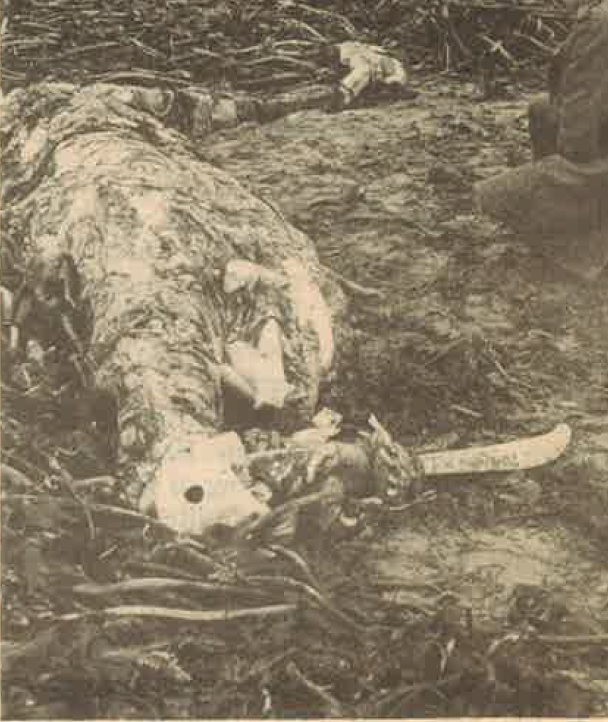
Fig.1. The Easthaven monster of December 1977 (The shark at Easthaven?, 1977). The kneeing man beside it could be photographer David Henderson of Dundee (Jackie Arcari, personal communication, January 9, 2021).

Monster on Easthaven beach, 1977

East Haven (also: Easthaven) is a fishing village near to the city Carnoustie in the council area of Angus, Scotland, Great Britain. In December 1977 a “monster”, “mystery corpse” or “prehistoric animal” washed up here on the shore, lying in seaweed. Though, the mystery apparently lasted not too long as the same newpaper-article reporting about it revealed the identity as basking shark (Cetorhinus maximus). The history of this little-known case will be examined from several sources like contemporary newspaper-articles and (popular-)scientific literature. The given identity of the creature will be explained from two photography, published in local newspaper Arbroath Guide and literature about “The basking shark in Scotland” from author Denis Fairfax.

Continue

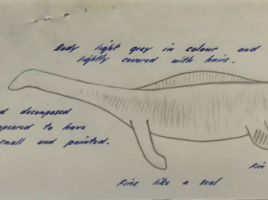
Picture of the original sketch of Charles Rankin of the carcass. Attached to a letter to Dr Stephen and later also shown during the interview in “Arthur C. Clarke’s Mysterious World”. (Courtesy of Christine Baird for National Museums Scotland. Retrieved from https://twitter.com/NMSlibraries/status/1200385620540981248).

Gourock sea serpent, 1942

The town of Gourock is located on the southwest coast of Scotland, in the upper Firth of Clyde, an inlet of the Atlantic Ocean. In close proximity to Gourock, at the anchorage of the Tail of the Bank, the British Home Fleet was stationed during the Second World War. It was during this time, in June 1942, that a purportedly intact „sea monster“ was discovered. Supposedly, due to a lack of interest from scientists and military restrictions on photography, the creature was not thoroughly examined or documented. Only a rough sketch was made by Charles Rankin, the reporting eyewitness and Burgh Surveyor, who also kept a bristle taken from one of its flippers. The remains were subsequently buried beneath the playing field of the present-day local school, St Ninian. It was not until 1980, when Rankin publicly shared his account on a British television series about unexplained phenomena, that the descriptions of the creature sparked various speculations regarding its true nature. In 2012, newspaper articles from 1942 were rediscovered, classifying the creature as a highly decomposed basking shark. Correspondences between Charles Rankin and former curator Dr. A. C. Stephen of the Royal Scottish Museum in Edinburgh were found at the National Museums Scotland Library in 2020. These correspondences provided additional insights into the matter and after thorough evaluation, it becomes evident that the most plausible explanation for the eyewitness account is a combination of genuine and non-genuine observations. As a result, the identification made by the Greenock Telegraph and the Gourock Times holds greater probability in the assessment: the carcass discovered in Gourock in 1942 belonged to a severely decomposed basking shark (Cetorhinus maximus).

Continue

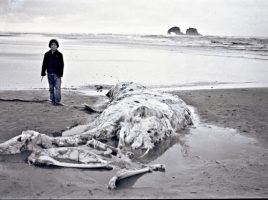
The “sea monster” with young Don Best (age 6-8) in the background at Rockaway Beach (Best, 2017. Courtesy of Don Best Photography).

Sea monster beached at Rockaway, 1951

Rockaway Beach is a city in Tillamook County in the West coast state of Oregon, USA. In July 1951 a “sea monster” washed up here on the shore of the Pacific Ocean, just opposite to Twin Rock. Seemingly only one newspaper-article was published in local press, which provided no positive identification of the creature. The history of this “overlooked” sea monster will be examined from this source as well as from the remembrance of family accounts of Mr William Browne and Mr Don R. Best. The identity of the creature will be explained from a private photography of Mr Best, published online in December 2017.

Continue

error: Content is protected